
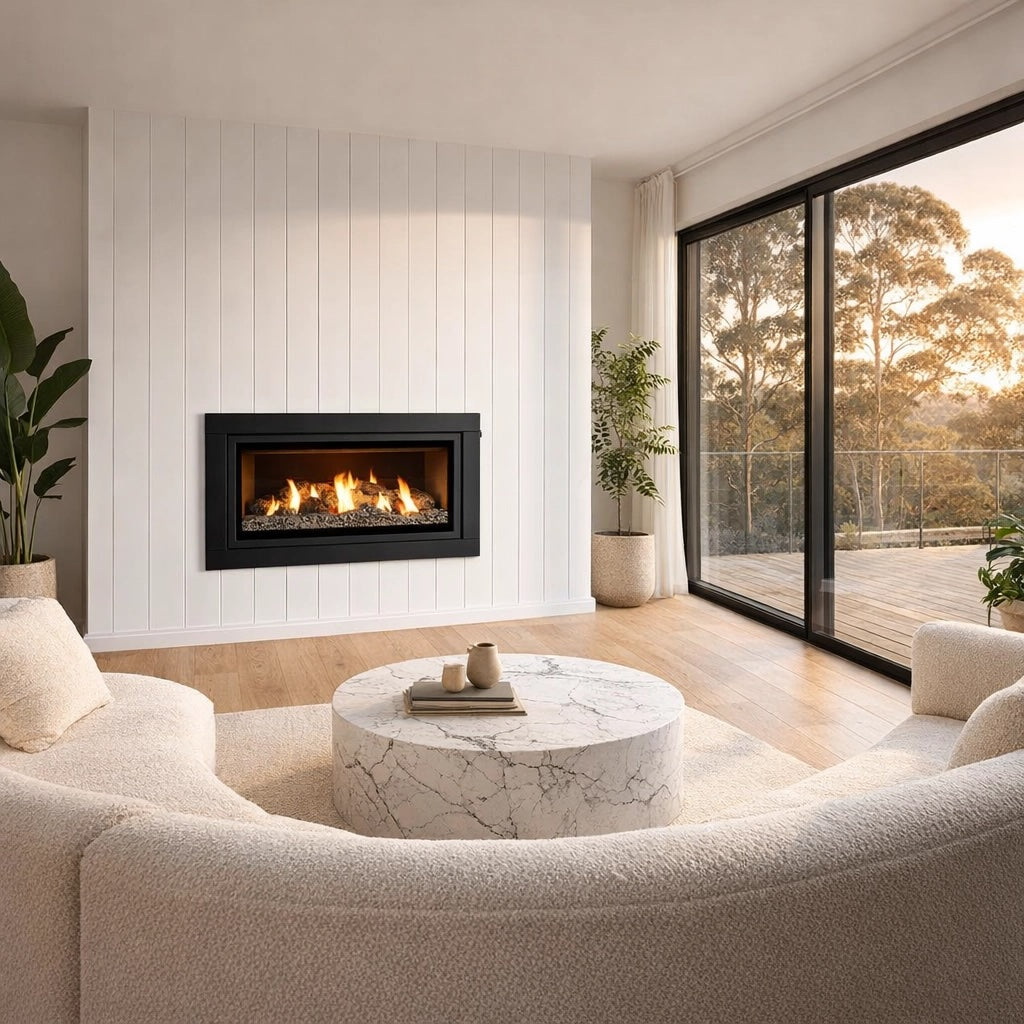

The old fireplace has been boarded up since before you bought the house. Someone painted the mantel white in the nineties. Behind the board there is a brick opening and a bit of soot. The chimney above it may or may not still be open at the top. You want a fire back in that space. The question is what will go in the hole.
An insert is a sealed fireplace unit fitted into an opening that already exists. That is usually an old masonry fireplace. An inbuilt is the same kind of unit built into a new cavity in a wall. Australian manufacturers mostly use the word inbuilt for both jobs. A product labelled inbuilt is often the insert you are after. Gas inserts need a flue and a licensed gasfitter. Electric inserts need a power point and no flue at all. What fits comes down to three things: the opening's height, its depth, and the state of the chimney.
What you have determines what fits
Three starting points cover most homes. Work out which one you are in before you look at any unit.
The first is a genuine masonry fireplace. Brick or stone, built for an open fire, with a chimney still running to the roof. This gives you the most options.
The second is a decommissioned opening. The fireplace is still there, but the chimney has been capped, filled or taken off at the roofline. The opening is a recess in the wall now. Gas is still possible here, though the flue has to be run as new work.
The third is a plasterboard wall with no opening at all. There is nothing to insert into. This is inbuilt territory, where a cavity gets framed and lined before the fire goes in.
Chimney condition can decide this for you before you have chosen anything. A chimney capped twenty years ago is not automatically a flue route. It has to be inspected. In some homes the answer comes back no.
Chimney condition can decide this for you before you have chosen anything.
There is a second problem worth knowing about early. In older homes across Melbourne's inner suburbs and around Geelong, the opening was built around an open fire. Depth is the measurement that usually causes trouble, more than width. A sealed unit needs room behind it that an open hearth never had to provide.
Apartments add one more step. Anything involving a flue or a new gas line normally needs owners corporation approval before a trade can start.
The gas insert path
A gas insert is a sealed gas log fire fitted into an existing opening. It runs on natural gas or LPG, and it needs a flue.
The flue on a modern unit is a balanced flue. That is a sealed pipe within a pipe. One passage draws air in from outside. The other carries exhaust back out. The unit uses no air from the room. This is the part people get wrong. The old chimney becomes a route for the flue. It does not act as the flue.
Installation is licensed gasfitter work. The standard covering it is AS/NZS 5601.1:2022 Gas installations, Part 1: General installations. It is kept current through regular amendments. Domestic gas log fires are Type A appliances. Energy Safe Victoria is clear that gas installation and servicing is work for a licensed gasfitter. This is not a job for a general handyman.
On the product side, the IB range is built for this job. The Luminar IB-1000 is rated to heat 40 to 50 square metres. There is a larger IB-2000 in the same range. Both run on natural gas or LPG, and both use a balanced vertical flue.
One detail is worth raising early. An insert rarely matches an old opening exactly, so a fascia covers the gap between the unit and the brickwork. Standard fascias suit standard gaps. An unusual opening may need a wider one, and that is a question to ask before you order.
The gas fireboxes carry a 10-year warranty. That matters more on a retrofit than on a new build. Getting back into a masonry opening years later is harder than opening up a plasterboard cavity.
Cost depends on the flue run, the state of the opening, and the length of the gas line. There is a full breakdown of installation cost in a separate article.
The electric insert path
An electric fireplace insert is a heater and flame effect that runs on power alone. It sits in the opening with no gas, no flue, no combustion, and nothing to vent.

The Velisse Aura range can be wall mounted or recessed. The recessed option is what makes it work as an electric insert. The Aura 2000 measures 1980mm wide and 363mm high. Smaller 1250 and 1650 models suit narrower openings. Flame colour, brightness, ember bed colour and crackle sound all adjust from a remote or a phone app.
Two things to be straight about. Electric units put out less heat than a gas log fire of a similar size. Treat one as a heater for a single room, around 20 to 25 square metres. A gas insert covers 40 to 50. And the flame is an effect. It looks its best in the evening with the room lights down.
The appeal of an electric insert in an old house is the work it avoids. No chimney inspection, no flue run, no roof access, and no gas line. That usually means a shorter install and fewer trades in the house.
Power is the other requirement. If there is no power point within reach of the opening, adding one is a licensed electrician's job. Ask in store about warranty terms on the electric range, because they work differently to the gas firebox warranty.
Recessing into a masonry opening still needs the depth checked. A recessed unit has to sit flush in the wall. Old openings were never built to a standard depth.
Which one fits your opening?
Here is how the three starting points line up against the three types of unit.
| What you have | Gas insert | Electric insert | New inbuilt |
|---|---|---|---|
| Open masonry fireplace, chimney still usable | Best fit. The balanced flue runs up inside the existing chimney. Licensed gasfitter only. | Works if the opening is deep enough and there is power nearby. | Not needed. You already have the opening. |
| Decommissioned or capped opening | Possible. The chimney is inspected first and the flue is run as new work. | Usually the simpler path. No flue involved at all. | Only worth it if the opening is being rebuilt anyway. |
| Plasterboard wall, no opening | Not an insert job. A new cavity has to be framed and lined. | Wall mounting is the easy option. Recessing means framing a cavity. | This is the inbuilt path, planned before the wall is closed up. |
If the chimney is sound and you want the room properly heated, gas is the stronger choice. If the chimney is capped, or the job needs to stay simple, electric removes the flue question entirely. For most people the chimney decides it before anything else does.
Frequently asked questions
Is a direct vent gas fireplace the same as a balanced flue?
In practice, yes. Direct vent is the North American term for a sealed unit. It draws combustion air from outside and sends exhaust straight back out. In Australia the same arrangement is called a balanced flue. If an American guide says direct vent, it is describing what an Australian gasfitter would call a balanced flue.
Can I put a gas insert into a fireplace that used to burn wood?
Often yes, though the chimney has to be inspected first. The flue then has to be run as a proper gas flue inside it. A licensed gasfitter makes that call after looking at the chimney, the opening and the roof line. Some old chimneys are too narrow or too deteriorated to take a flue.
Do I need to keep the chimney if I go electric?
No. An electric insert has nothing to vent, so the chimney plays no part in the install. Some owners cap it and leave the chimney breast in place, because it frames the fire well. Others fill the flue and keep the mantel as a shelf.
What to measure before you visit a showroom
Bring numbers and bring a photo. Those two things turn a long conversation into a short one.
- Opening height and width, measured at the front
- Opening depth, front to back at the deepest point
- Whether the chimney is still open at the top, or capped
- Whether there is a power point within reach of the opening
- A photo taken square on, with the mantel and hearth in frame
Measure the opening before you fall in love with a model. Depth is the number people forget, and it is the one that rules models out fastest.
Measure the opening before you fall in love with a model.
Showrooms across Victoria, South Australia, Western Australia and New South Wales have gas and electric units running side by side. Bring your measurements and your photo, and the conversation can start with what fits.

Leave a comment
This site is protected by hCaptcha and the hCaptcha Privacy Policy and Terms of Service apply.