
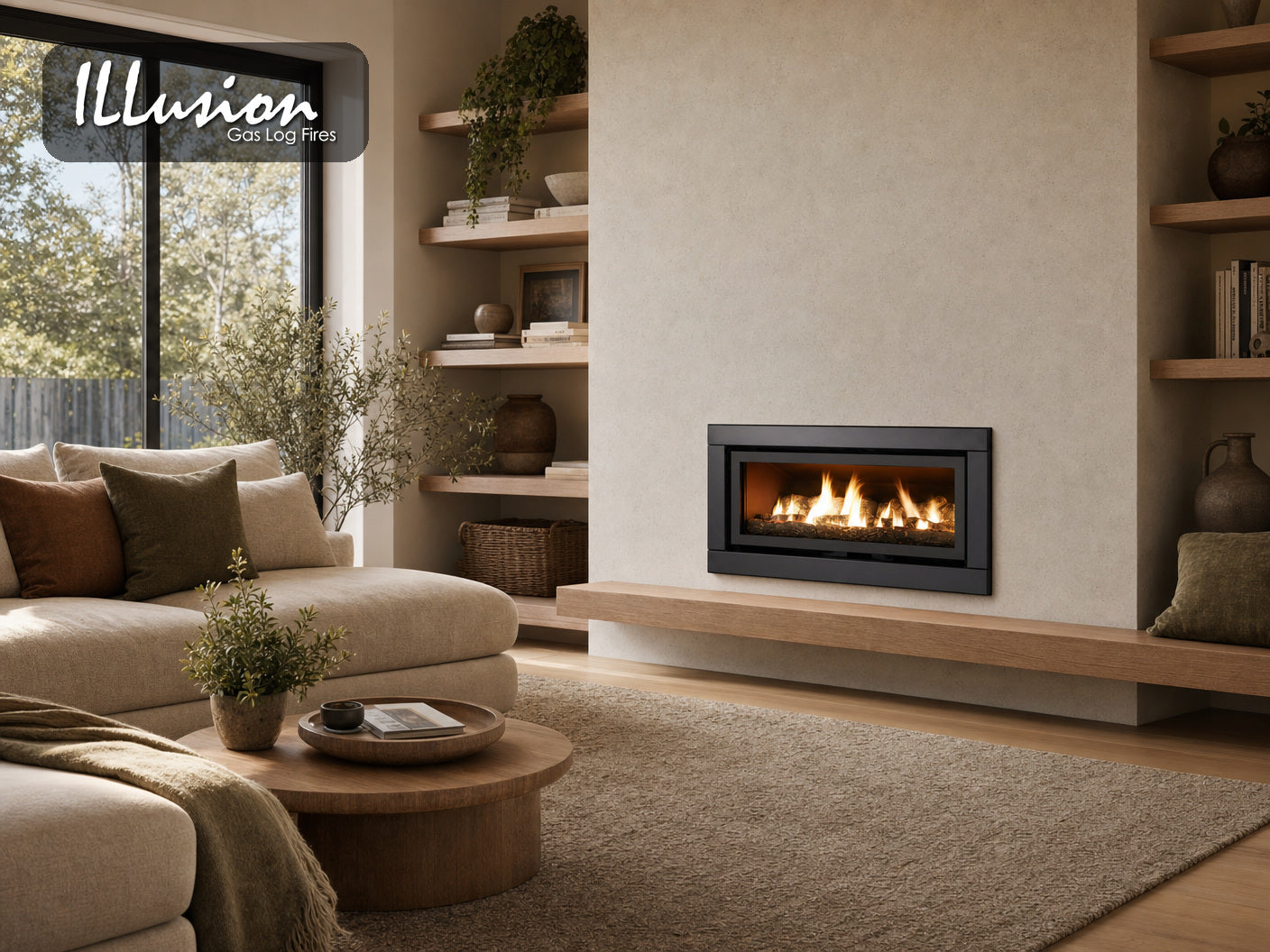
 Gas log fires are built and labelled for one gas type before they leave the factory.
You have found the fire. The room is measured and the wall is settled. Then comes the question about gas type. There is no mains connection at your meter, so the answer is LPG. Now you want to know what that changes.
Most gas log fires are built for either natural gas or LPG. A natural gas heater and the LPG version of the same model are not identical inside. The injector is smaller on LPG and the gas runs at roughly twice the pressure. Some models put out a little less heat on bottled gas. For the owner, three things change: running cost, refills, and where the bottles sit outside. LPG usually costs about twice as much per megajoule as mains gas in Victoria.
Is an LPG heater the same as a natural gas heater?
The firebox, the logs, the glass and the flue are the same. What changes is the gas train, the set of parts that meters the fuel and burns it.
LPG stands for liquefied petroleum gas, the propane sold in bottles. It packs more energy into a smaller volume than mains gas. So it is fed through a narrower opening at a higher pressure.
The numbers are specific. On one mid-sized Australian inbuilt, the natural gas injector measures 2.6 mm across. The LPG version of the same model measures 1.8 mm. Manifold pressure rises from about 0.9 kilopascals to about 1.6.
Gas input can drop too. That mid-sized model is rated at 32 megajoules an hour on natural gas and 29 on LPG. A smaller model in the range drops from 20 to 16. The difference is modest, but it is real. Size the fire to the room using the LPG figure rather than the headline one.
What does a gas log fire cost to run on LPG?
More than mains gas. How much more comes down to what you pay for a bottle.
Victorian households pay around 3.5 cents per megajoule for natural gas. A 45 kg LPG bottle holds about 2,205 megajoules. Refills commonly run $140 to $180, which works out at roughly 6 to 8 cents per megajoule.
On a mid-sized fire, the hourly figures look like this. Natural gas, about $1.10. LPG, about $1.80 to $2.35. Our guide to gas fireplace running costs sets out the natural gas side in full.
The buyers who regret LPG sized the fire for the room and never priced the winter's bottles.
Across a season the gap widens. Four hours a night through a four-month winter is about 480 hours of fire. Held on high the whole time, that is close to six 45 kg bottles. Call it $880 to $1,140 for the season.
Few people run a fire flat out all evening. Turned down, most units drop to about two thirds of their high rating. The thermostat handles that once the room is warm.
The buyers who regret LPG sized the fire for the room and never priced the winter's bottles.
What running on bottled gas involves day to day
Most homes on LPG keep two 45 kg bottles side by side. An automatic changeover valve joins them. When the first empties, the second takes over without you noticing. The changeover indicator is your cue to order a refill.
On high, a mid-sized fire empties a 45 kg bottle in about 75 hours. At four hours an evening, that is around 19 nights from one bottle. Call it five weeks from a pair.
That is the fire alone. Cooking and hot water draw from the same two bottles. A household already on LPG will see the refill cycle shorten once the fire goes in.
The bottles live outside. Where they sit is governed by AS/NZS 1596:2014, the standard for the storage and handling of LP Gas. Your supplier positions and connects them. This is what they are checking:
- Upright, on a firm base that does not collect water
- At least 1.5 metres clear of anything that could spark: power points, switches, air conditioners, pumps, sensor lights
- Away from windows, doors and vents, so a leak cannot find its way indoors
- Away from drains and pits, because LPG is heavier than air and sinks
- Reachable by the delivery truck, with a clear path and gates unlocked
Bottle rental is usually charged on top of the gas. Expect roughly $30 to $60 a year per bottle. Ask before you sign, because some suppliers fold it into the refill price and others do not.
On high, a mid-sized fire empties a 45 kg bottle in about 75 hours.
Can you convert a gas fireplace from natural gas to LPG?
Sometimes. It depends on the model, and it is never work for the owner.
The appliance data plate decides it. That is the label inside the control door. It lists the model, the approved gas type, and the pressure the appliance must run at. If the plate does not cover the other gas, the fire stays on the gas it was built for. No kit changes that.
Where a conversion is allowed, a licensed gasfitter fits the manufacturer's kit. New injectors go in and the pressure is reset at the valve. The regulator is checked and often replaced, and the plate is relabelled for the new gas.
The gasfitter then runs the fire on high and low and watches the flame. Flames lifting off the burner ports mean the pressure is still wrong.
All of it is licensed work. Victoria's Gas Safety Act 1997 requires gasfitting to comply with AS/NZS 5601.1 Gas Installations Part 1: General installations. That standard is kept current through regular amendments. Energy Safe Victoria requires your gasfitter to hand you a compliance certificate. Keep it. It is the document that obliges them to come back and fix a faulty installation.
Which fuel suits your home?

If there is mains gas at the meter, that is your answer. Natural gas is cheaper per megajoule, there are no bottles to order, and every model is available for it.
If there is no mains connection, LPG is what makes a real flame possible at all. Think of homes past the network around Ballarat, through the Adelaide Hills, or across rural Western Australia. Most are already on bottles for cooking and hot water. A gas log fire is one more appliance on a supply that is already there.
One Victorian point is worth knowing. New homes must be all-electric from 1 January 2027 and cannot take a new mains gas connection. LPG sits outside those rules. If you are building beyond the network, raise it with your building surveyor early.
| Natural gas | LPG | |
|---|---|---|
| Running cost | About 3.5 cents per megajoule in Victoria. Roughly $1.10 an hour on a mid-sized fire. | Roughly 6 to 8 cents per megajoule. About $1.80 to $2.35 an hour on the same fire. |
| Supply | Continuous from the mains. A daily supply charge applies to the connection either way. | Two 45 kg bottles outside, refilled on order. Bottle rental is usually extra. |
| Heat output | The full rated input for the model. | Slightly lower on some models. Check the LPG rating. |
| Installation | The gasfitter connects to the existing gas line. | The gasfitter connects through a regulator and changeover valve. Bottle clearances apply. |
| Where it works | Most of metro Melbourne and established suburbs. | Anywhere, including past the mains network. |
| Victorian rules | No new connections for new homes from 1 January 2027. | Not covered by the gas connection changes. |
Frequently asked questions
Is an LPG heater more expensive to run than a natural gas heater?
Yes, usually about double per megajoule. Mains gas in Victoria runs around 3.5 cents per megajoule. LPG in 45 kg bottles works out at roughly 6 to 8 cents. Your refill price and your distance from the depot decide where you land. On a mid-sized fire, that is about $1.10 an hour against about $2.
Can I run a natural gas fire off a bottle from the service station?
No. A fire built for natural gas has the wrong injector and the wrong pressure setting for LPG. Connecting it to bottled gas is unsafe. The small 9 kg bottles sold for barbecues are also not a domestic heating supply. A fixed LPG installation uses 45 kg bottles, a regulator and a changeover valve, all fitted by a licensed gasfitter.
Do I need a bigger fire if I am on LPG?
Sometimes. Some models are rated slightly lower on LPG. A unit that suits your room on mains gas may sit just under what you need on bottles. Check the LPG rating rather than the headline figure. If you are close to the limit, step up a size. Our guide to sizing a gas heater for your living room works through the measurements.
Confirm the gas before the order goes in
The gas type is settled at the factory rather than on delivery day. The injector goes in and the compliance plate is printed before the fire leaves the Dandenong South workshop. An LPG unit is ordered as an LPG unit from the start. Getting it wrong means a conversion later, if the model allows one at all.
So confirm which gas you are on before the order is placed. Check the meter, or check what your hot water runs on. Then take that detail and a photo of the space into a showroom. There are showrooms across Victoria, South Australia, Western Australia and New South Wales. The fire can be specified for the right fuel the first time.

Leave a comment
This site is protected by hCaptcha and the hCaptcha Privacy Policy and Terms of Service apply.