
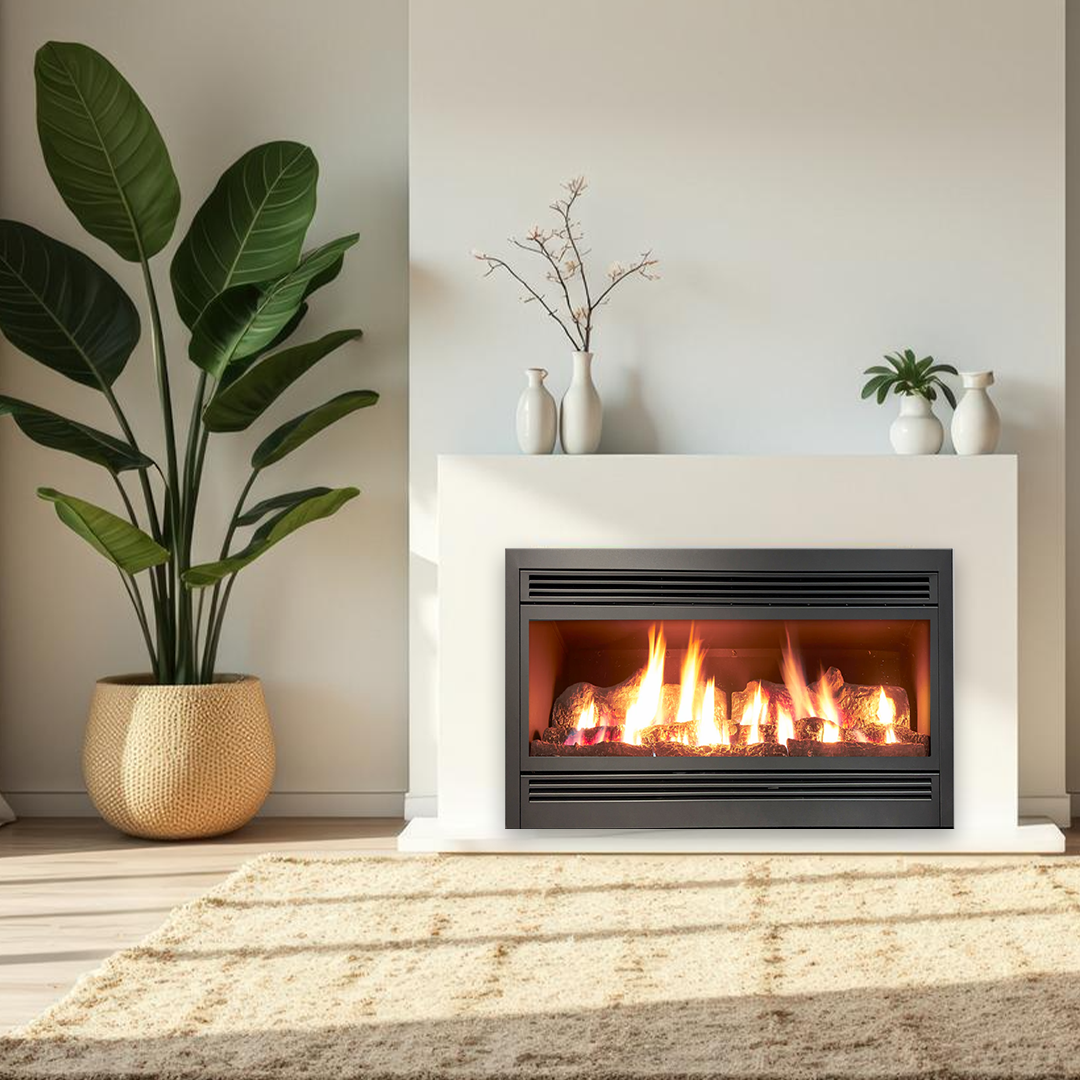
You’re in a showroom looking at five different gas heaters. They all look great. But the one that suits a 20-square-metre bedroom is completely wrong for a 60-square-metre open-plan living area. Getting the size right matters – too small and you’ll never feel warm enough, too large and you’re paying to heat air you don’t need.
Choosing the right size indoor gas heater comes down to one number: kW output. Here’s how to work it out before you visit a showroom.
How does gas heater sizing actually work?
When you look at a gas heater’s specifications, you’ll see two numbers that look similar but mean very different things.
MJ/h (megajoules per hour) is the gas input – how much fuel the heater consumes. kW (kilowatts) is the heat output – how much usable warmth the heater actually delivers into your room. These are not the same thing, and confusing them is one of the most common mistakes people make when comparing gas fireplaces.
Two gas heaters can both consume 25 MJ/h of gas but deliver very different amounts of heat. The difference comes down to efficiency, shown on the energy label as a star rating. A higher-rated heater converts more gas into warmth and less into waste.
For example, a 25 MJ/h gas heater with a 5.8-star rating delivers roughly 6.2 kW of heat output. The same 25 MJ/h input with a 2.8-star rating delivers only about 5 kW – that’s 24% less heating from the same amount of gas.
When you’re comparing gas heaters, always compare kW output, not MJ/h input.
How many kW do I need for my room?
As a starting point, you need roughly 1 kW of heat output for every 10 square metres of well-insulated room with standard 2.4-metre ceilings. A 40-square-metre living room needs about 4 kW. A 20-square-metre bedroom needs about 2 kW.
But that’s a baseline for moderate climates with good insulation. In colder parts of Victoria or inland Australia, the figure shifts closer to 1 kW per 8 square metres. And several other factors can push the number up or down.
Here’s a quick guide to matching room size with gas heater capacity:
|
Room type |
Approx. size |
kW output range |
What to look for |
|
Small bedroom or study |
15–20 sqm |
1.5–2.5 kW |
A compact gas heater handles this comfortably. Don’t oversize – too much heat in a small room wastes gas and makes the space uncomfortable. |
|
Standard living room |
30–40 sqm |
3–4.5 kW |
This is where most gas log fires sit. Mid-range models are designed for exactly this category. |
|
Large living or dining room |
40–60 sqm |
4.5–6.5 kW |
You’ll need a higher-output unit. The Illusion Fires Matrix range, which heats 80–120 sqm, covers these spaces comfortably. |
|
Open-plan living area |
60–100+ sqm |
6.5 kW and above |
Open-plan layouts lose heat faster because warm air spreads across a larger volume. Look at models rated for 100+ sqm, such as the Matrix or Realistic 5000. |
These ranges assume reasonable insulation and standard ceiling heights. If your home is older, poorly insulated, or has high ceilings, expect to size up.
What else affects how well a gas heater performs?
Room size gives you a starting point, but these factors can shift the answer:
Insulation quality. A well-insulated home holds heat far better than one with old or missing insulation. Poor insulation can increase your heating requirement by 10% or more. If yours is lacking, fixing that first is often cheaper than oversizing the heater.
Ceiling height. Standard ceiling height in Australian homes is 2.4 metres. Raked, cathedral, or double-height ceilings mean more air volume to heat – and warm air rises, so more of it ends up above your head rather than where you’re sitting.
Windows. Large windows, especially single-glazed ones, lose heat quickly. Homes with floor-to-ceiling glass in the living area often need a higher-output gas heater than the floor space alone would suggest. Good curtains or blinds make a real difference.
Which direction the room faces. South-facing rooms in Australia get less natural warmth than north-facing rooms, especially in winter. A south-facing living room in Ballarat needs more heating capacity than a north-facing room of the same size in bayside Melbourne.
Where you live. Climate zone matters. Homes in Ballarat, the Macedon Ranges, or Gippsland need noticeably more capacity than homes in inner Melbourne or along the coast. If you’re in a colder region, lean toward the upper end of the kW range for your room size.
What are the most common sizing mistakes?
Buying the biggest heater ‘just in case’. An oversized gas heater cycles on and off constantly – it heats the room too quickly, shuts down, then restarts when the temperature drops. This wastes gas, adds unnecessary wear on the unit, and creates an unpleasant cycle of too-hot and too-cool. Bigger is not always better.
Ignoring insulation. Two homes with identical floor plans but different insulation can need very different heater sizes. If your home is draughty or poorly insulated, addressing that first is a more cost-effective fix than buying a more powerful heater to compensate.
Treating open-plan as one enclosed room. A 60 sqm open-plan kitchen, dining, and living area is not the same as a 60 sqm room with four walls and a door. Heat dissipates faster in open layouts because there’s nothing to contain it. Size your heater for the full open area, not just the corner you sit in.
Comparing MJ/h instead of kW. This is the most common technical mistake. Two heaters with the same MJ/h input can deliver very different heat outputs depending on their efficiency rating. Always compare kW output – it tells you how much warmth actually reaches the room.
What should I do next?
Measure your room – length times width gives you the floor area in square metres. Note the ceiling height, and have a rough idea of whether your insulation is good, average, or poor.
Then bring those numbers to your nearest Illusion Fires showroom. Our team will match the right gas log fire to your space, whether that’s a compact model for a bedroom or a high-output unit like the Matrix or Realistic 5000 for a large open-plan living area. With showrooms in Dandenong, Epping, Geelong, Ballarat, Adelaide, Perth, Sydney, and Newcastle, there’s one near you.
Frequently asked questions
How many kW do I need per square metre?
About 1 kW of heat output per 10 square metres in a well-insulated home with standard 2.4-metre ceilings. In colder regions or poorly insulated homes, you may need 1 kW per 8 square metres or more.
What’s the difference between MJ/h and kW on a gas heater?
MJ/h is the gas input – how much fuel the heater uses. kW is the heat output – how much warmth it delivers. A heater with a higher star rating converts more gas into heat. Always compare kW when choosing between models.
Can a gas fireplace heat a whole house?
A gas log fireplace is designed to heat one room or living zone effectively. It’s not a replacement for a ducted system, but it’s an excellent choice for warming the room you spend the most time in – typically the main living area.
Is a bigger gas heater always better?
No. An oversized heater wastes gas, cycles on and off constantly, and can make the room uncomfortably hot. The right size delivers consistent, comfortable warmth without wasting energy.
Does ceiling height affect what size heater I need?
Yes. Higher ceilings mean more air volume to heat, and warm air naturally rises. Rooms with raked or cathedral ceilings typically need a higher-output heater than standard-height rooms of the same floor area.

Leave a comment
This site is protected by hCaptcha and the hCaptcha Privacy Policy and Terms of Service apply.