
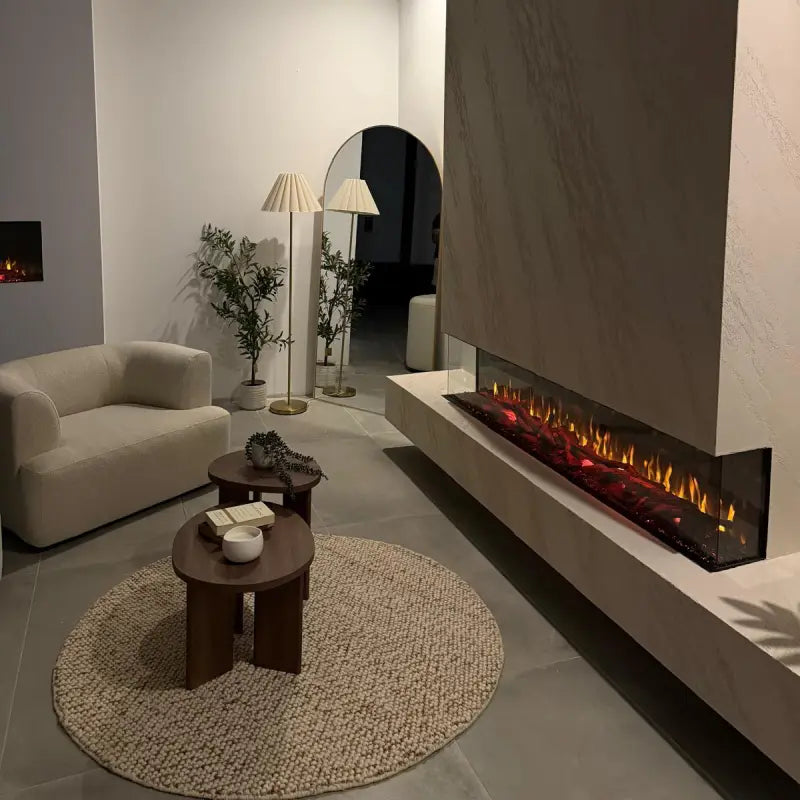
You have found an electric fireplace you like. It looks right on the wall, the flame is convincing, and the install looks simple. The one thing holding you back is the question every showroom hears: what does it cost to leave it running?
Here is the straight answer. An electric fireplace heater costs about 60 to 70 cents an hour on full heat, and close to nothing on flame-only mode. Most units draw around 2 kilowatts (kW) and warm a room of roughly 20 to 25 square metres. Illusion Fires makes gas fireplaces in Dandenong South and carries the Velisse Aura electric range, and this running-cost question is one buyers ask us most. The figures below break it down per hour, per evening, and across a winter.
How much does an electric fireplace cost to run per hour?
An electric fireplace turns electricity straight into heat, so its running cost is simply the power it draws multiplied by your electricity rate. On full heat that is about 60 to 70 cents an hour.
Most electric fireplaces have three ways to run: flame-only, low heat, and high heat. The flame effect uses very little power on its own, usually under 100 watts. The heating element is where the cost sits, and most units cap at around 2 kW. Australian households pay between 30 and 35 cents per kilowatt-hour in 2026, with Victoria at the lower end of that band.
Here is what that works out to. The figures assume a 2 kW unit and a Melbourne winter evening of about four hours.
| Setting | Power drawn | Per hour | Per evening (4 hrs) | Across a winter* |
|---|---|---|---|---|
| Flame only | 0.1 kW | about 3c | 12 to 14c | $11 to $13 |
| Low heat | 1 kW | 30 to 35c | $1.20 to $1.40 | $110 to $125 |
| High heat | 2 kW | 60 to 70c | $2.40 to $2.80 | $215 to $250 |
*The winter figure assumes four hours every evening for about three months at that setting. Most people use a mix of settings and a thermostat, so a real bill usually lands lower.
The table makes the pattern clear. Flame-only costs a few dollars across a whole winter. Even on full heat, a single fireplace warming one room is a modest line on a quarterly bill. The cost only climbs if you run high heat for long stretches in a big space. If you want to see the units these numbers apply to, the Velisse Aura electric range is a good place to start.
What is the difference between kW and kWh on your power bill?
A kilowatt (kW) measures power, the rate at which an appliance uses electricity. A kilowatt-hour (kWh) measures energy, the total amount used over time, and it is the unit your retailer charges for.
A 2 kW electric fireplace draws 2 kW the whole time the heater is on. Run it for one hour and it uses 2 kWh. Run it for four hours and it uses 8 kWh. Your bill multiplies those kilowatt-hours by your rate. At 30 cents, eight kilowatt-hours costs $2.40.
This is why the flame effect is so cheap. It draws about a tenth of the power of the heater, so it barely moves the meter. The heating element is the part that costs money, and you control that with the thermostat and how long you leave it on.
Is an electric fireplace cheaper to run than a plug-in heater or a gas fire?
Per hour, an electric fireplace costs about the same as any other 2 kW plug-in heater, and less than a gas log fire. The comparison changes once you look at the heat you get for the money.
A portable plug-in heater and an electric fireplace both turn electricity into heat at the same efficiency. A 2 kW column heater and a 2 kW electric fireplace cost the same to run. The fireplace gives you a flame effect and a fixed spot on the wall; the portable heater gives you nothing to look at but moves between rooms.
A gas log fire is a different machine. It costs more per hour, roughly 70 cents to $1.80 on natural gas, but it puts out far more heat: 5 to 6 kW or more, against about 2 kW from an electric unit. For a small room or short evenings, electric is the cheaper way to take the chill off. For a large open-plan space you want warm all night, a gas fire heats faster and more thoroughly for the money.
When is an electric fireplace the cheap choice, and when isn't it?
An electric fireplace is the cheapest fireplace to run when you are heating one room for short stretches or running the flame for ambience. It works out dearer than gas or a reverse-cycle system when you are trying to heat a large space all day.
It is the cheap choice when:
- Heating a single room. Warming the lounge for a few hours after dinner is what an electric fireplace is built for. You heat the room you are sitting in rather than the whole house.
- You mostly want ambience. The flame effect runs for a few cents an hour. If the look matters more than the heat, electric is hard to beat on cost.
- There is no gas connection. For an apartment, a townhouse, or a home with no gas line, an electric fireplace skips the cost of a flue and a gasfitter.
It is not the cheap option when:
- You are heating the whole home. Electric resistance heat costs more per unit of warmth than a reverse-cycle split system, which moves three to four times more heat than the power it uses.
- The space is large and used all day. A single 2 kW unit struggles to heat a big open-plan area, so it runs flat out for longer and the cost adds up. A higher-output gas fire usually does that job for less.
Common questions about electric fireplace running costs
Does running just the flames use much power?
No. The flame effect on most electric fireplaces draws under 100 watts, about the same as a couple of light globes. Left on for four hours every evening through winter, it adds only $11 to $13 to your power bill.
How much will an electric fireplace add to my winter bill?
On full heat for four hours a night across a Melbourne winter, expect roughly $215 to $250. Most homes pay less, because the thermostat cycles the element off once the room is warm.
Is it cheaper to heat one room with an electric fireplace or run ducted heating?
For a single room, the electric fireplace is usually cheaper. Ducted heating warms the whole house to warm one part of it, while the fireplace heats only the space you are using.
Do bigger electric fireplaces cost more to run?
Not by much. Most electric fireplaces cap their heater at around 2 kW no matter how wide the unit is, so a long wall-mounted model costs about the same per hour as a compact one. The width changes the look and the flame, not the power draw.
Are electric fireplaces dear to run next to a reverse-cycle split?
Per unit of heat, a reverse-cycle split is cheaper, because it moves heat rather than making it from scratch. An electric fireplace wins on a lower upfront price, simple installation, and a flame you cannot get from a wall unit.
Get the room size right and the bill stays low
The biggest lever on running cost is not the brand or the flame. It is matching the unit to the room. A 2 kW heater suits about 20 to 25 square metres. Ask it to heat double that and it runs longer and costs more for a result that never quite satisfies.
Before you buy, measure the room and write down the square metres. Then see the Velisse Aura range in person at an Illusion Fires showroom across Victoria, South Australia, Western Australia and New South Wales, and ask the staff which output matches your space. Getting that one number right is what keeps the bill low.

Leave a comment
This site is protected by hCaptcha and the hCaptcha Privacy Policy and Terms of Service apply.