
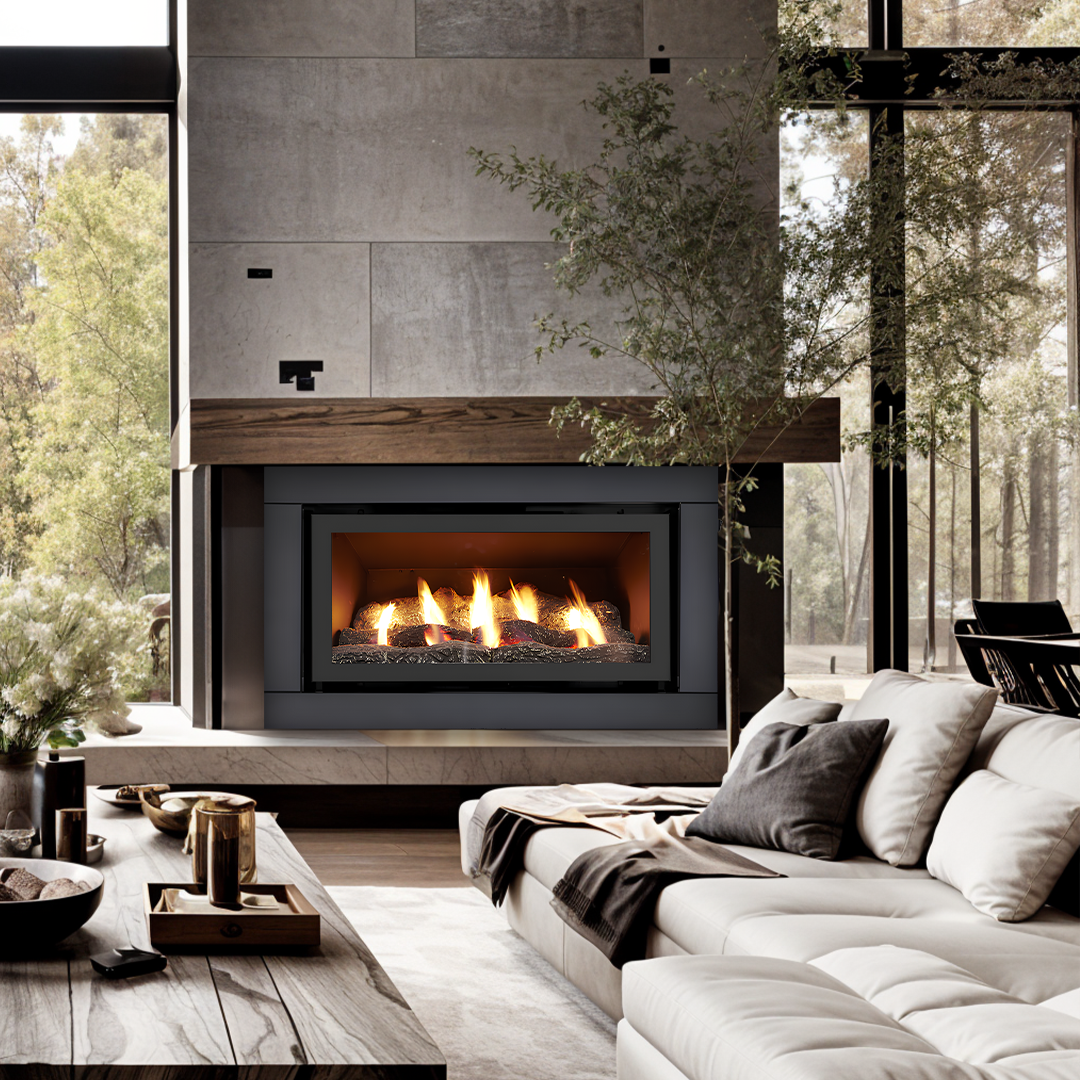
You've decided you want a gas log fireplace. You've spent an hour clicking through collections on a manufacturer's website, maybe walked into a showroom, and the choice is bigger than you expected. Eight collections, dozens of models, three install types, several flame styles, and separate decisions on the controls, the frame, and the flue. Most buyers start with the look, because that is what catches the eye in the showroom or on the homepage.
The right order is different. This article is the framework an Illusion consultant uses when a customer brings that decision into the showroom. It works the same way every time: where the gas log fireplace is going, then how much heat the room needs, then the flue, then the controls, then the look. Each decision narrows the ones below it. Get the sequence right and the field shrinks fast. Get it wrong and you spend weeks on models that were never going to fit your room or your budget.
The five decisions, in the right order:
- Where the fireplace is going (inbuilt, freestanding, or insert)
- How much heat the room needs (kW output)
- The flue (route, location, type)
- The controls (remote, ignition, smart features)
- The look (flame style, frame, collection)
Each decision narrows the next. The article walks through them in order.
Start with where the fireplace is going
The first decision is install type. Three options cover most homes:
- Inbuilt gas log fireplace: built into a wall cavity. Suits new construction, renovations where you can frame in around the unit, or an existing chimney space that can be opened up. Reads as a flush design feature in the wall.
- Freestanding gas log fire: sits proud in the room with a flue exiting through a wall or ceiling. Works in homes without an existing chimney and where you do not want to lose wall depth to a cavity. Heat radiates more evenly because the unit is exposed.
- Insert: replaces an existing solid fuel unit inside a chimney. Uses the chimney as the flue route. The most cost-effective path if you have a chimney that is no longer used or no longer safe to burn wood in.
Install type decides three things downstream: how much heat the unit can put out (cabinet sizes carry different burner ratings), what flue route is available, and which flame and frame styles are on the table. Choose this first and the next decisions narrow themselves.
Three questions sort most homeowners into the right install type. Do you have an existing chimney? If yes, an insert is the simplest path. If not, an inbuilt or freestanding unit is on the table. Are you starting from scratch in a renovation or new build? Inbuilt is the default, because the wall can be designed around the unit rather than the unit fitted into an existing wall. Is the fireplace primarily a feature, primarily a heat source, or both? Inbuilt leans toward feature with serious heat. Freestanding leans toward heat with a strong visual presence. Insert depends on the existing chimney.
How much heat the room needs
Heat output is measured in kilowatts. The Australian rule of thumb for a well-insulated room with average ceiling height (around 2.4 metres) is about 1 kW for every 10 square metres of floor space. A 30 m² living room needs around 3 kW. A 60 m² open-plan kitchen, dining, and lounge needs around 6 kW. If your ceilings are 2.7 metres or higher, the space is poorly insulated, or the heat needs to flow into a hallway and the rest of the house, the figure goes up.
The most common sizing mistake is undersizing because the figure was calculated on visible floor area without accounting for ceiling height or open-plan flow. The unit runs flat-out and never quite warms the room. Oversizing has its own cost: a unit that is too big for the room cycles on and off, which shortens its life and wastes gas.
For a more thorough sizing walk-through, see our sizing guide. The short version: take the floor area, adjust for ceiling height and insulation, factor in any rooms the heat needs to flow into, and you have a target output range to bring to the showroom.
Flued or unflued: the question that decides everything else
Most homeowners do not know that flued and unflued gas heaters are two different categories of appliance with different rules. The decision has already been made for you if you are buying a gas log fireplace from Illusion: every Illusion gas log fireplace is flued. The category matters anyway, because it explains why some products you see online cannot legally be installed in a Victorian living area, and it shapes the conversation about flue routes that comes next.
A flued appliance is sealed to a flue that exits the building. Combustion gases travel up the flue and outside. On a room-sealed model, combustion air is also drawn from outside, so the room air is left alone entirely. This is the standard for any space heater installed in an Australian living area. An unflued appliance vents combustion gases back into the room and relies on room ventilation to manage them.
Here is how the two compare on the points that affect a buying decision:
| Flued gas log fireplace | Unflued gas heater | |
|---|---|---|
| Combustion gases | Vent outside through a flue | Vent into the room |
| Living-area use in Victoria | Standard for any built-in installation | Not permitted in domestic homes |
| Bedroom use | Allowed for some models, subject to clearances | Not permitted under AS/NZS 5601.1 |
| Air supply | Drawn from outside on most modern room-sealed units | Drawn from the room |
| Typical purchase price | $2,500 to $8,000+ supply | Under $1,500 for portable units |
| Used by Illusion | Every Illusion gas log fireplace is flued | Not used in any product |
The flue route is the practical implication once you commit to a flued unit. A flue can run vertically through the roof or horizontally through an exterior wall. Vertical is simpler and the standard answer for single-storey homes. Horizontal opens up installation options in townhouses, apartments, and rooms with restricted ceiling access, but the route needs a clear path through an exterior wall and clearance from windows, eaves, and adjoining property boundaries.
Gas appliance installation in Australia is governed by which is kept current through regular amendments. Domestic gas log fireplaces are classified as Type A appliances, and installation must be carried out by a licensed gasfitter holding a Type A endorsement. Any showroom worth visiting will walk you through the flue route options for your specific home before you put a deposit down.
The flame, the logs, and the look


Once install type, sizing, and flue are settled, the look opens up. Three primary flame and bed styles cover most preferences:
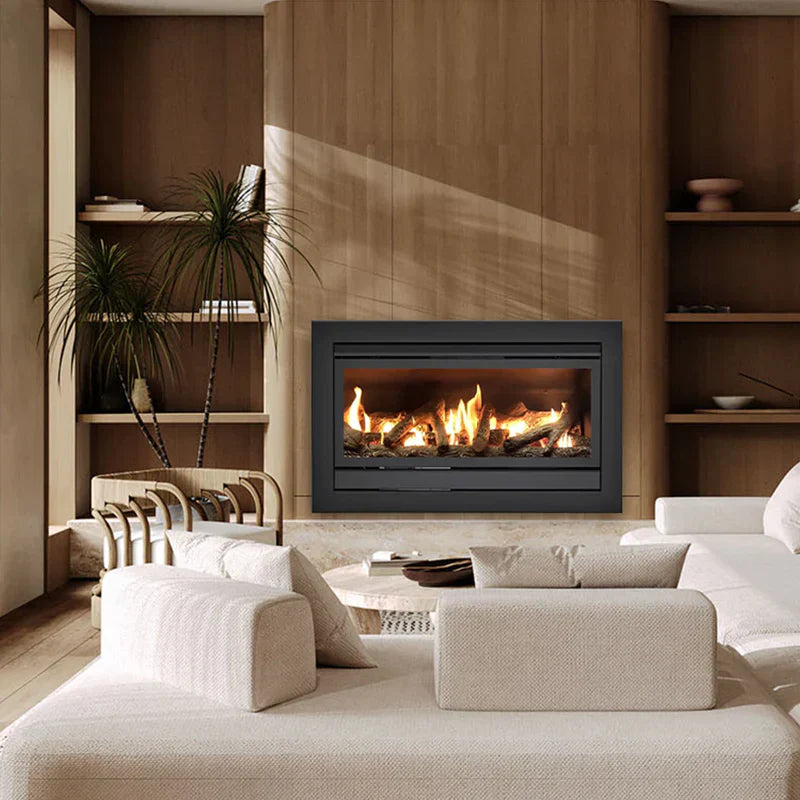
- Ceramic logs: the traditional look. Hand-crafted ceramic logs sit on the burner, glowing as they heat. Suits classic interiors, period homes, and anyone who wants the gas fireplace to read like a wood fire.
- Glass or crystal beds: the contemporary look. A bed of glass or ceramic crystals replaces the logs, giving a clean modern flame without log silhouettes. Suits minimalist and architectural interiors.
- Coal-effect: the heritage look. Designed for period and Federation homes where the fireplace would historically have been a coal grate.
Realistic flame technology has moved on a long way since the early 2000s. Three things to look at in the showroom: flame height (does it fill the firebox?), flame movement (does it look natural across the burner?), and ember bed glow at the lowest setting (a fireplace turned down should still look like a fire). Firebox depth and shape change how the flame reads from a viewing position, so spend time looking at the unit from the seat where you will sit at home.
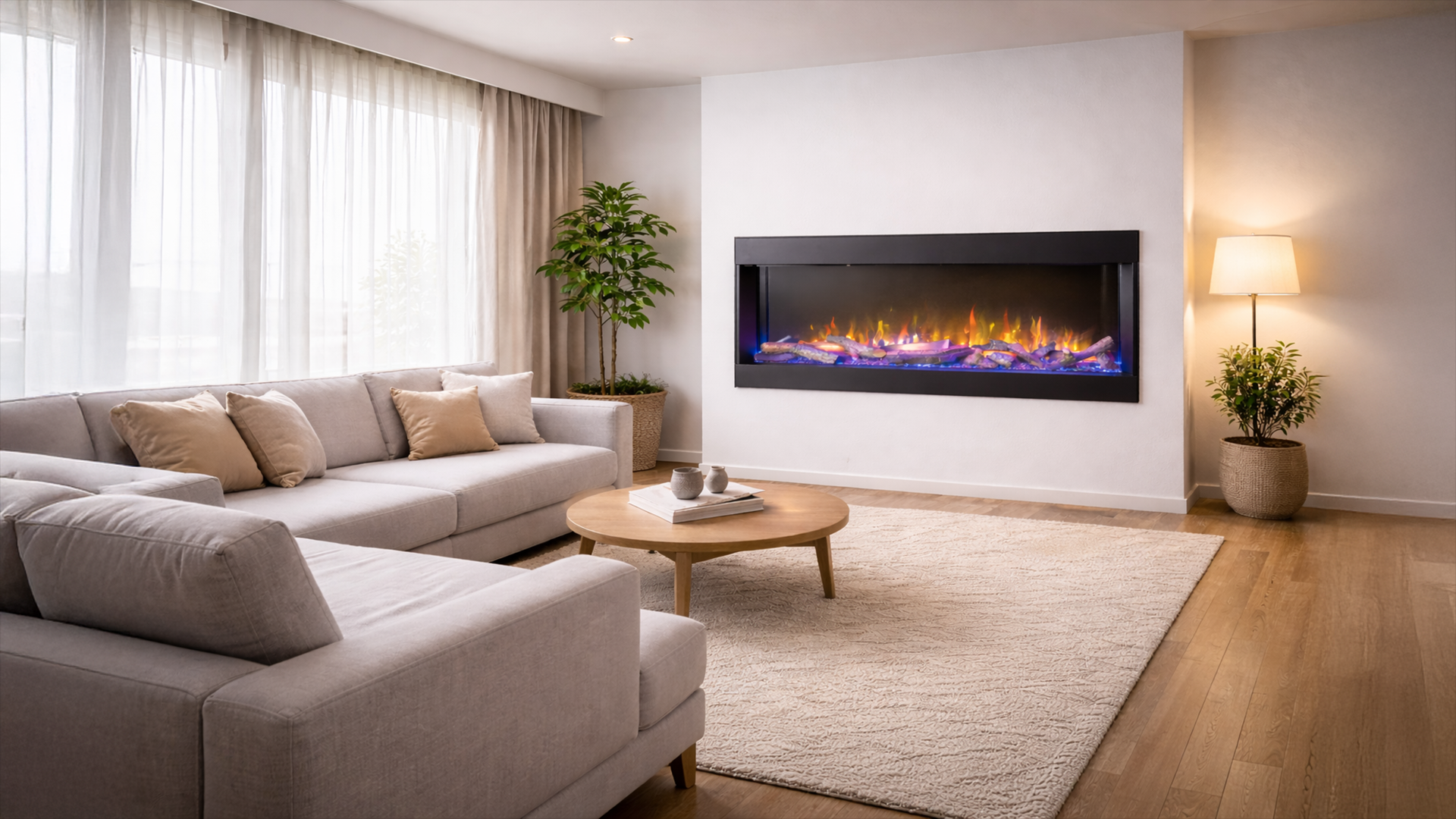
Frame style is the second design layer. Traditional brick surrounds, modern flush-mount frames, panoramic three-sided units, and one-sided wall-mount panels each carry a different design language. Match the frame to the room: a flush black frame in a contemporary open-plan space, a brick surround in a Federation lounge.
Illusion's collections are different design answers to the same heat-output requirement. The Luminar collection sits at the contemporary end with linear flame beds and slim frames. The Realistic collection takes the traditional log-fire approach with hand-crafted ceramic logs and a deeper firebox. Walking through two or three contrasting collections in the showroom is the fastest way to feel which design language fits your home.
Convenience, controls, and reliability
The phrase "modern gas fireplace" carries some practical meaning in 2026:
- Remote control as standard across the range.
- Programmable thermostats and timers on most models, so the fireplace can pre-warm a room before you sit down.
- Wifi and smart-home integration on the higher-end collections.
- A choice of ignition system. Millivolt ignition does not need mains power and lights on a small standing pilot. IPI or electronic ignition lights on demand and is more efficient at standby, but it needs mains power or a battery backup to run during a power cut.
The ignition decision matters more than it sounds. A flued gas fireplace can keep working through a power outage if the ignition runs on millivolt. The fan won't run without mains power, so heat distribution drops, but the fire will light and stay lit. An IPI unit without battery backup will not start during an outage. If your area loses power often during winter storms (the Dandenong Ranges and the Yarra Valley in Victoria, parts of regional NSW and SA), ask the showroom which collections support millivolt ignition.
Running cost is the other practical question at this stage. A gas log fireplace zone-heats the room you sit in for less than a ducted system warming the whole house, but the per-hour comparison against reverse cycle is closer than many buyers expect. Our running cost guide walks through the numbers for typical Victorian homes and gas tariffs. The short version: gas log fireplaces are competitive on running cost when used as zone heating, and become more competitive the colder the climate.
Buying a gas log fireplace from a manufacturer or a reseller
At showroom-visit stage, the choice between buying from a manufacturer and buying through a reseller becomes a real consideration. The differences are not always obvious from the outside.
A manufacturer-direct purchase means the company that built the unit is the company you deal with from quote to install to service call ten years later. The same engineers who designed the burner answer the technical questions. Spare parts come from the same factory. Warranty claims go through one channel. Pricing reflects the manufacturer's cost without a reseller margin layered on top.
A reseller relationship works through more steps. The reseller buys from a manufacturer, marks the price up, and represents the brand to the buyer. Warranty claims pass back through the reseller. Technical questions get answered by salespeople rather than the people who built the unit. Spare parts availability depends on the reseller's relationship with the brand, and the relationship can change.
Australian-made versus imported is more than national pride. Service, parts, and warranty support are different in practice when the manufacturer is in the same country, and even more so when the manufacturer is in the same city. Illusion designs and manufactures every gas log fireplace at its Melbourne factory. A burner that fails in year seven means a replacement from the same factory, with no six-week container wait from overseas. A buyer in Geelong or Adelaide deals with an Australian warranty department.
The 10-year firebox warranty anchors the manufacturer-direct value case. Ten years is meaningful because the firebox determines how long the unit serves the room. Burners, valves, and ignition components can be serviced or replaced; the firebox is the part you do not want failing. A 10-year firebox warranty paired with a manufacturer-direct service path is the value extension that distinguishes buying direct from buying through a reseller.
What to bring to the showroom (and what to ask)
The framework above is enough to start the conversation. Walking into the showroom prepared makes the rest of it faster.
Bring
- Room measurements: width, depth, ceiling height. A photo with a tape measure visible is worth more than the numbers alone, because it shows the proportions of the wall.
- Photos of the wall the fireplace would sit on, plus the surrounding room and the seating arrangement.
- Existing chimney details if there is one: internal flue diameter, condition, what the chimney is made of, when it was last swept and inspected.
- A sense of how often the fireplace will run. Every winter night for four months changes the calculation; occasional weekend use changes it again.
- Photos of finishes you like elsewhere in the house. They save guesswork on frame style.
Ask
- What heat output do you recommend for my room, given the ceiling height, insulation, and any open-plan flow?
- What flue route works for this wall? What does that route cost to install?
- What is the install timeframe to my schedule? Lead times stretch from May onwards as winter approaches.
- What does the warranty cover, in plain language? Which components have shorter warranty terms, and what does that mean over ten years?
- What is the service network in my suburb? Who comes out for a service call in year five?
A consultant who can answer those five questions clearly is one worth listening to. A consultant who hedges or talks past the questions is one to walk away from.
A gas log fireplace sits in the wall for 15 to 20 years. The wall is built around it. The frame, the flue, and the install are committed to the unit, and the unit is committed to the room. Changing the spec later means changing the wall, which is rarely worth the cost. Worth getting the spec right the first time.
Illusion's showrooms run across Dandenong, Epping, Geelong, and Ballarat in Victoria, plus Adelaide, Perth, Sydney, and Newcastle. Walking through two or three contrasting collections with a consultant who can run the framework above with you takes about an hour. That hour saves weeks of online comparison and the costlier risk of changing the spec after the wall is built.

Leave a comment
This site is protected by hCaptcha and the hCaptcha Privacy Policy and Terms of Service apply.