
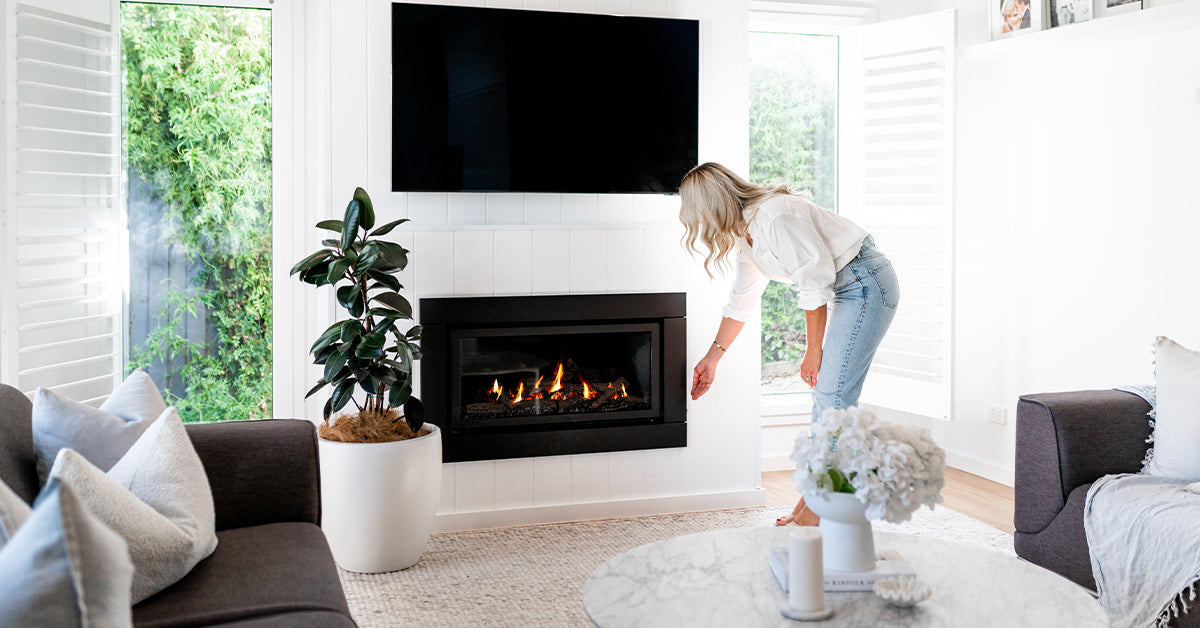
You're standing in the lounge, the fireplace selected, the carpenter asking where the TV goes. Both on the same wall, or one wall each? Mount the TV above the fireplace and you save a wall. Get it wrong and you spend the next ten years with a sore neck on movie nights, or a TV that fails years earlier than it should.
Short answer: yes, you can. Whether you should depends on which fireplace you've chosen and how you watch TV. As Australia's largest gas log fireplace manufacturer and maker of the Velisse Aura electric range, Illusion works with renovators on this decision every week. Our gas log and electric units are built at our Melbourne factory. Gas log behaves one way for heat. Electric behaves another.
The two concerns that drive the call are heat damage to the TV and viewing height for long sessions. Everything else is solvable. If you're earlier in the renovation and haven't settled on the fireplace itself, our built-in fireplaces planning guide covers what to plan before the framing carpenter starts.
The two real concerns about mounting a TV above a fireplace
A TV mounted above a fireplace faces two problems that don't apply anywhere else in the house. Heat damage, and viewing height. Everything else (cable management, aesthetic balance, proportions) follows from how you handle those two.
The heat problem is physical. A working fireplace pushes heat upwards. A TV mounted in the rising heat plume sits in higher temperatures than it was designed for. The damage builds up across years of use, slowly shortening the TV's working life.
The viewing problem is ergonomic. Fireplaces sit close to the floor for visual weight, then rise upwards. Adding a TV above pushes the screen centre well above seated eye level. A short news segment is fine. A three-hour Saturday-night movie is the thing people regret.
Both problems have solutions. Some are cheap (choose electric, lower the TV). Others mean committing to a design call earlier in the renovation than feels comfortable. The rest of this article works through each one.
How much heat does a gas log fireplace produce?
A typical inbuilt gas log fireplace produces 4 to 8 kW of heat output. Most of that radiates from the front of the unit into the room. A smaller portion rises vertically as convected hot air. The rising column is what the TV above the fireplace has to live in.
Surface temperatures at the top of a working gas log unit can sit around 200°C during peak burn. Ambient air temperature one metre above the unit can sit between 60°C and 80°C, depending on the unit's design and how heat is transferred. These figures vary by model. Some Illusion units run cooler at the top because more heat is directed forward; others run hotter. The unit's spec sheet has the exact figures for your model. Those matter more than the general principle.
For comparison, Samsung, LG and Sony TVs are all rated to operate at ambient temperatures up to 40°C. Above that, the manufacturer's specification stops protecting you. The internal electronics work harder, in a hotter environment, for longer than the design intended.
Sudden failure is rare. The more common pattern: a TV that should have lasted ten years and starts showing pixel issues at six. Colour calibration drifts. The power supply gives out earlier than it should.
Across our seven Illusion gas log collections (Luminar, Azura, Matrix, Mystique, Realistic, Millenium and Esprit), surface temperatures and clearance figures vary by model. The spec sheet is the source of truth, and the installer works from it.
How much heat does an electric fireplace produce?
Much less, and the heat goes in a different direction. The Velisse Aura electric range typically runs at 1.5 to 2 kW of heat output, with most of that fan-blown out the front of the unit rather than rising vertically through the top.
The practical effect: the top surface of an electric fireplace stays close to room ambient temperature during operation. A TV mounted above sits in air barely warmer than the rest of the room. The 40°C TV operating threshold isn't relevant because the temperature never approaches it.
This is the honest reason electric fireplaces are the easier choice for TV-above-fireplace mounting. The physics genuinely favours electric in this one specific scenario. Gas log offers something electric doesn't, including the radiant heat output, the genuine flame, and the heating capacity for a cold Melbourne winter. On TV-above mounting alone, gas log carries a constraint electric doesn't.
If you've chosen electric for the look and ease of use, you've also chosen the fuel that makes TV-above mounting straightforward. Worth knowing if the wall layout matters more than maximum heating performance.
Side by side on the heat-related factors:
| Factor | Gas log fireplace | Electric (Velisse Aura) |
|---|---|---|
| Typical heat output | 4 to 8 kW | 1.5 to 2 kW |
| Top-surface temp at peak | Around 200°C | Close to room ambient |
| Ambient air 1m above unit | 60 to 80°C | Close to room ambient |
| Direction of heat | Radiant forward plus rising column | Fan-blown forward |
| Heat clearance for TV above | Required, per spec sheet | Negligible |
| TV-above suitability | Possible with care | Straightforward |
The viewing height problem with a TV above a fireplace
The viewing-height issue outlasts the heat issue. A damaged TV gets replaced. A wall layout you regret is a renovation.
Industry guidance for comfortable TV viewing is to have your eye line at, or slightly above, the centre of the screen when seated. For a typical sofa, seated eye height sits between 1,000 mm and 1,200 mm above the floor. That puts the ideal TV centre somewhere in the 1,000 to 1,300 mm range above the floor for sustained viewing.
A typical inbuilt gas log fireplace sits with its top edge around 1,200 to 1,400 mm above the floor. Add the heat-clearance gap above the unit (refer to the spec sheet for your model) and the bottom edge of the TV. A 65-inch TV's centre is around 300 mm above its bottom edge. The TV centre lands somewhere between 1,600 mm and 2,000 mm above the floor.
That's well above comfortable viewing height. The neck angle works for short bursts. Long sessions compound. People notice it by the third hour of a movie.
The fix nobody likes: lower the TV as far as the wall allows. Every 100 mm dropped reduces the neck angle on a long session by a measurable amount. A floor-line electric unit makes this easier than a tall inbuilt gas log with a generous mantel.
If your room geometry forces the TV high (low ceiling, tall fireplace surround, close seating), splitting the layout starts to make more sense than persisting with TV-above mounting.
When does mounting a TV above the fireplace work?
Five scenarios where TV-above-fireplace mounting works long-term:
- You've chosen an electric fireplace. The heat physics is manageable, the surface stays cool, and the TV operates in normal room temperatures. The Velisse Aura range is the simplest path here.
- You watch TV mostly in short bursts. News bulletins, sport highlights, music videos, casual viewing while the kids do homework. The neck angle doesn't compound on a 20-minute session.
- The room functions as a formal sitting space. The fireplace is the visual centrepiece. The TV is secondary. The compromise on viewing height is worth the design payoff.
- You have a deep mantel. A 100 to 150 mm deep mantel acts as a heat deflector. Combined with adequate clearance, it makes a gas log unit workable for TV-above.
- The fireplace sits low enough that the TV lands at acceptable height. Rare with inbuilt gas log. More achievable with a floor-line electric unit or a freestanding gas log fire where the burner sits low.
When should you split the layout instead?
Equally clear scenarios where TV-above is the wrong call:
- You've chosen a high-output gas log fireplace and plan to use it most winter evenings. The duty cycle compounds across years. Heat exposure adds up even when it's within spec on any single night.
- The lounge is the family's main TV room. Long viewing sessions are the trigger for neck strain. A weekly family movie night for a decade is a long-running test of the layout, and the layout fails first.
- You watch a lot of movies or sport. Duration is the variable that matters, more than time of day.
- The room is narrow and the seating sits close to the wall. Close-range viewing of a high-mounted TV gives a worse neck angle than the same TV viewed from further back.
- You're at the wall-design stage and have flexibility. Easier to design two zones now than to retrofit a fix later.
When this is the right call, put the fireplace on one wall as the visual centrepiece and the TV on a perpendicular wall or inside a media cabinet. If you're creating a dedicated feature wall, our guide to designing a chimney breast for a modern fireplace can help you plan the proportions, structure and finished look before construction begins.
In Melbourne open-plan extensions, the common version is the fireplace on the long wall facing the kitchen island, with the TV on a short return wall serving the seating zone. The fireplace is visible from kitchen and dining. The TV serves the sofa.
How to mount a TV above a fireplace safely
Six steps make the difference between a setup that works and one you regret:
- Choose an electric fireplace where possible. The Velisse Aura range is designed with no flue, manageable surface temperatures, and a slimmer profile that allows the TV to sit lower.
- If gas log, choose a unit with a deep mantel built into the surround. The mantel deflects heat forward, away from the wall above. A 100 to 150 mm depth is typical. The spec sheet for your model has the exact figure.
- Specify non-combustible material between the fireplace and the TV mount. Rendered masonry, stone veneer, or fire-rated lined plaster. Size it to the clearance figure on the unit's spec sheet.
- Plan cable management before the wall closes up. Run an in-wall conduit from the TV position down to the cabinet, with a power point behind the TV. Easy at framing. Expensive after plasterboard.
- Lower the TV as much as the wall allows. Every 100 mm saved on TV centre height reduces neck angle on long sessions. Aim for the minimum clearance above the unit.
- Confirm clearance with the installer. Gas log installation requires a Type A gas-licensed installer working to AS/NZS 5601.1:2022 with Amendment 2 from September 2024. Electric Velisse Aura units need a licensed electrician.
Cable management and aesthetic balance
Safe and good-looking are two different problems. Five details handle most of the aesthetic side:
- In-wall cable conduit. Run a wide-enough conduit from the TV mount position to the cabinet before plasterboard. A 50 mm conduit accepts future upgrades (HDMI 2.2, audio, new consoles) without reopening the wall.
- Power point behind the TV. Coordinate with the electrician at rough-in. Eliminates the visible power lead. The most common aesthetic failure on retrofits.
- Mantel as visual break. A substantial mantel between the fireplace and the TV gives the eye somewhere to rest, and stops the wall reading top-heavy. For more ideas on creating a cohesive fireplace feature, see our fireplace styling tips for creating an inviting space.
- TV size relative to fireplace width. The TV should be narrower than the fireplace surround for visual balance. The wider room layout matters too, so consider how the fireplace, TV, furniture and seating work together. Our guide on how to style your living room has more ideas for creating a balanced living space.
- Off-white or matte wall finish. Reduces flame reflection on the TV screen. After viewing height, this is the most common aesthetic regret renovators voice once the fireplace is in use.
Bring your numbers to a showroom
If you're weighing both options, bring your numbers to a showroom: wall width, ceiling height, seating distance, intended TV size, and floor-to-ceiling height. The consultants at the eight Illusion showrooms (Dandenong, Epping, Geelong, Ballarat, Adelaide, Perth, Sydney and Newcastle) work through this decision with renovators every week. Every unit is built at our Melbourne factory with a 10-year firebox warranty.
One last point. The cable conduit and power point behind the TV are the cheapest pieces to install while the wall is open framework, and the most expensive to retrofit later. Whichever way you decide on TV-above, getting the cabling right at framing stage is the single biggest piece of futureproofing for under a hundred dollars of plastic conduit.
Frequently asked questions
Will heat from a gas fireplace damage my TV?
A working gas log fireplace pushes ambient air temperature one metre above the unit to between 60°C and 80°C during peak burn. Samsung, LG and Sony TVs are rated to operate up to 40°C ambient. Sustained exposure above the rated range gradually shortens the TV's working life through cumulative pixel and electronics stress. The damage is usually gradual, which is why people don't notice it for years.
How high should a TV be mounted above a fireplace?
The general rule for comfortable seated viewing is to mount the TV centre between 1,000 mm and 1,300 mm above the floor. Above a fireplace, the unit's top edge plus heat clearance forces the TV centre higher, often between 1,600 and 2,000 mm. Lower the TV as much as the unit's spec sheet allows. Every 100 mm saved reduces neck angle on long viewing sessions.
Is it safe to put a TV above an electric fireplace?
In most cases, yes. Electric units like the Velisse Aura produce 1.5 to 2 kW of fan-blown heat directed forward, rather than upward. The top surface stays close to room ambient temperature during operation. The heat objection to TV-above mounting effectively disappears with electric. Viewing height is still worth considering, but the heat physics is straightforward.
What clearance does a gas fireplace need between the unit and a TV?
Clearance is set by the unit's spec sheet rather than a universal figure. A mantel of 100 to 150 mm depth, combined with the manufacturer-specified clearance above the unit, is typical for gas log installation. Confirm the exact figure with a Type A gas-licensed installer working to AS/NZS 5601.1:2022 with Amendment 2 from September 2024.
Can I run TV cables behind the fireplace wall?
Yes, and you should plan this before framing closes up. Run an in-wall conduit from the TV mount position down to the cabinet, and have the electrician add a power point behind the TV. Both jobs are straightforward at rough-in stage and far more expensive to retrofit after plasterboard, mantel and surround are installed.

Leave a comment
This site is protected by hCaptcha and the hCaptcha Privacy Policy and Terms of Service apply.