
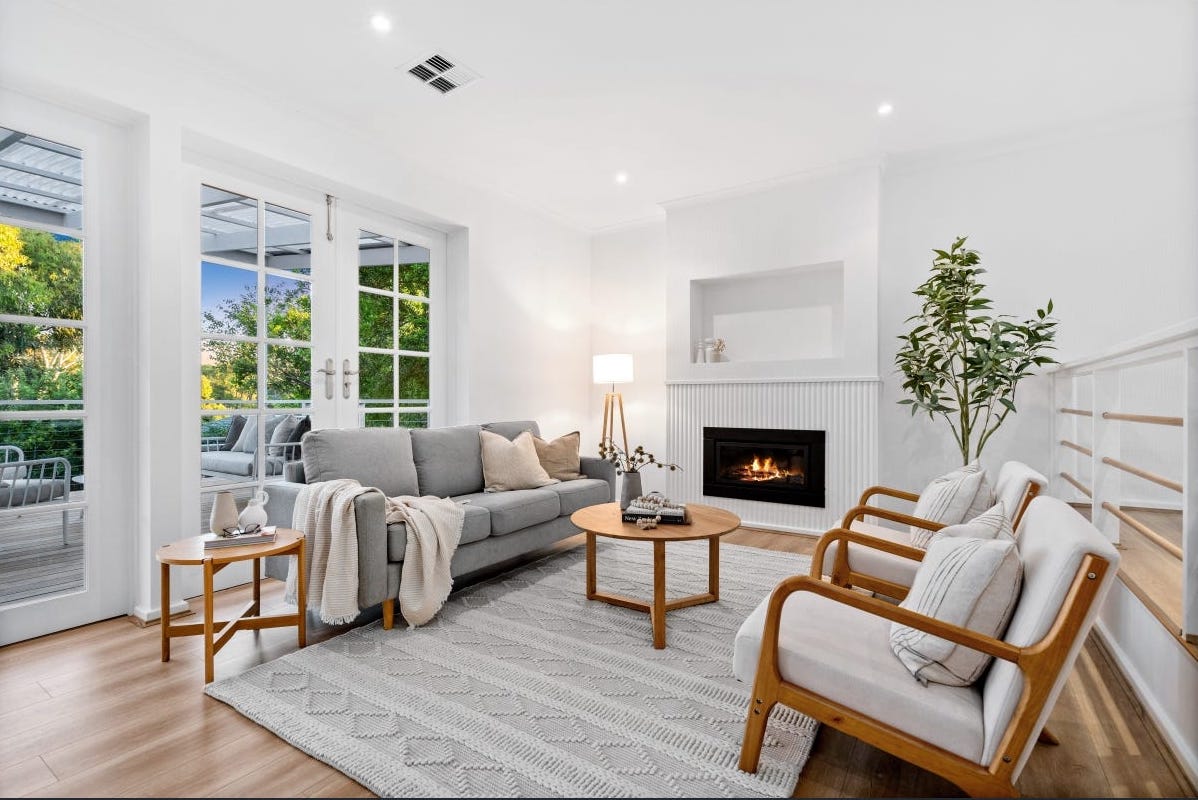
The floor plan is on the kitchen bench. You've chosen the fireplace, the framing date is locked in, and the carpenter is asking what the wall around the unit should look like. Do you need a traditional chimney breast that projects out from the wall? Can the whole wall sit flush with the fireplace face? Or is the better answer somewhere in between?
In a modern home, an indoor chimney rarely takes the full structure of an old brick chimney. The wall that wraps the fireplace gets locked in early; redesigning it later means stripping back to studs.
Illusion Fires manufactures gas log and electric fireplaces in Melbourne, and the chimney breast question comes up at our showroom consultations every week. This article walks through what the breast does in a modern build, the three design approaches that work for inbuilt fireplaces, and what each path costs in wall depth and flue geometry. If you haven't yet locked in the fuel choice and cavity dimensions, start with our companion article on built-in fireplaces first.
What a chimney breast does in a modern home
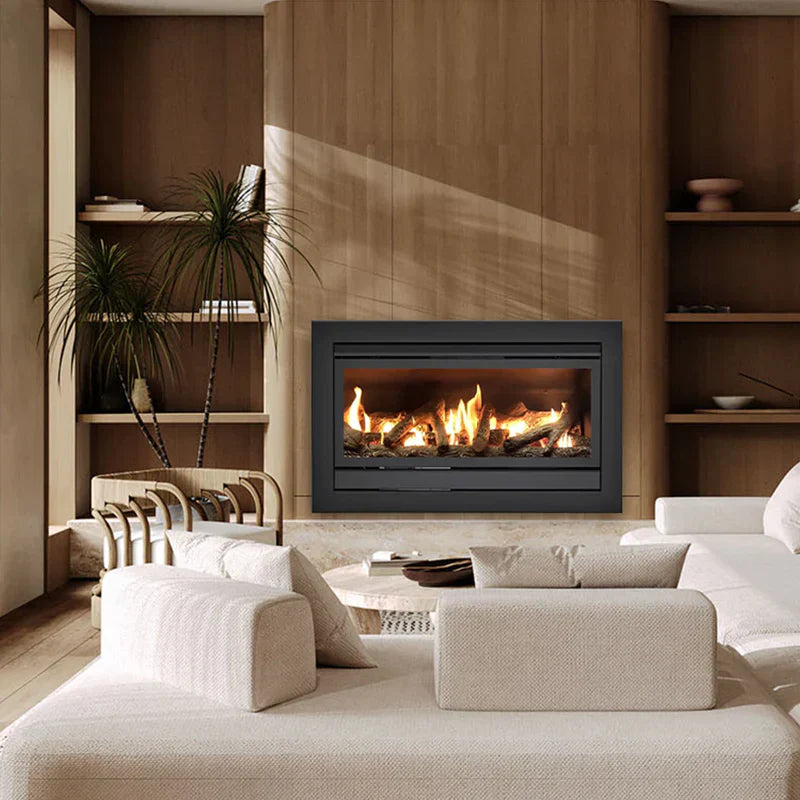
A chimney breast is the wall structure that projects forward from the surrounding wall to enclose the fireplace and, for gas log inbuilts, the flue path running up to the ceiling. In older homes, this was a full brick chimney running floor to roof. In a modern build, it's a framed structure (timber or steel stud, lined with fire-rated plasterboard where the manufacturer's spec sheet calls for it) that wraps the unit and any flue componentry, then carries the wall finish up to the ceiling.
The breast does two jobs. It houses the fireplace cavity, sized to the unit's spec sheet, and it gives the flue a path upward through ceiling and roof.
In a modern build, three approaches cover almost every situation:
- A traditional protruding breast that steps out from the surrounding wall (industry-typical 200 to 400 mm projection)
- A flush feature wall where the whole wall plane sits forward to match the fireplace depth
- A full-wall surround with no projection at all, which is mostly feasible for slim-line electric units
The choice between them depends on the fireplace you've selected, the flue geometry if there is one, the structural wall behind the fireplace, and the look you want. Each is covered below.
Do you need a chimney breast for an inbuilt gas log fireplace?
You need somewhere for the cavity and the flue, but it doesn't have to project from the wall. Inbuilt gas log fireplaces need a framed cavity matching the unit's spec sheet (industry-typical 700 to 1,500 mm wide, 600 to 900 mm tall, 300 to 450 mm deep plus a flue path running upward to discharge.
The flue decides whether the wall sits flush or has to project. If the wall is on the building's perimeter and the flue can run straight up through ceiling and roof, a flush feature wall works. If the flue has to offset around joists, beams, or upper-floor framing, a protruding breast often becomes the practical solution because it gives the offset somewhere to live.
Illusion manufactures seven collections of gas log inbuilts in Melbourne: Luminar, Azura, Matrix, Mystique, Realistic, Millenium, and Esprit. Cavity dimensions vary across them. The carpenter frames to the spec sheet of the model you've chosen rather than to a generic cavity. Settling on the unit before framing day matters. Changing the model later means reframing the cavity.
What changes for an electric fireplace
Electric units (Illusion's Velisse Aura range) need no flue, which changes the chimney breast question from structural to architectural. The cavity is shallower (often under 200 mm for wall-mounted models and nothing has to run above the unit.
You can build a feature wall to any depth because there's no flue path to accommodate. A slim-line electric unit can sit flat against the existing wall, with surrounding cladding or finish carrying the look.
This is the easier path for renovators whose flue geometry won't work for a flush gas log install. If the room above the fireplace wall sits awkwardly, or the upper-floor structure won't allow a clean vertical flue run, electric removes the constraint entirely. The trade-off lives in heat output rather than wall design.
The three design approaches in detail
Each of the three approaches suits different rooms, fireplaces, and flue conditions. Here's how they compare.
| Approach | Best suited to | Depth from wall | Works with | Typical cost implication |
|---|---|---|---|---|
| Protruding breast | Period homes, classic styling, awkward flue runs | 200 to 400 mm projection | Any gas log or electric unit | Lowest. Least wall framing required |
| Flush feature wall | Modern open plan, clean lines | Full wall built out 300 to 450 mm | Gas log with favourable flue geometry, electric units | Higher. Full wall depth across feature width |
| Full-wall surround | Modern minimalist, slim-line installs | No projection (sits flat against wall) | Electric units, shallow gas log models | Variable. Driven by cladding choice |
A protruding breast is the most flexible. It works with any fireplace and gives the flue path somewhere to live. In an older home, it usually suits the architecture.
A flush feature wall is the cleanest look for a modern open plan. The whole wall plane sits forward to match the fireplace depth, so the unit reads as part of one flat surface. It needs the flue to run straight up without offset, and the wall has to be built out by 300 to 450 mm across the full feature width.
A full-wall surround is the most restrictive of the three. The unit sits flat against the existing wall with surrounding cladding carrying the look. This works for electric units and shallower gas log models, but won't work for deeper inbuilts that need full cavity room.
What dictates which approach works for your home
Five factors decide which approach works for your room.
- Flue geometry. Does the flue have a straight vertical path from the fireplace to the roof, or does it need to offset around joists, beams, or upper-floor framing? Straight runs are flush-feasible; offset runs usually want a protruding breast.
- Ceiling height. A 400 mm protruding breast reads heavier in a 2.4 m ceiling room than in a 2.7 m ceiling room.
- Room proportions. Narrow rooms read better with flush walls. Larger rooms can carry a breast without losing balance.
- Existing structural wall. A load-bearing wall behind the fireplace constrains the design. In older Melbourne housing stock (Edwardian, inter-war), the load-bearing wall often sits exactly where the renovator wants the fireplace, which limits cavity depth and forces framing choices.
- Architectural style. A traditional protruding breast suits a Federation house. A flush feature wall suits a 2024 polished concrete extension.
The right answer is rarely about preference. Flue geometry and structural wall often eliminate one or two approaches before styling enters the conversation.
Materials and finishes
The wall finish does more than set the look. It affects clearance requirements, fireplace longevity, and how the wall ages.
The main options:
- Render and paint. The most common modern finish. Smooth, paintable in any colour, easy to update later.
- Stone or stone veneer. Reads textural and substantial. Real stone is heavier and needs the framing engineered for it; veneer gets close to the look at lower weight and lower cost.
- Tiles. Large-format tiles in concrete or stone-look porcelain are popular on modern flush walls. Tile installation is precise work and the grout lines matter.
- Timber cladding. Warmer and softer than stone, but timber needs to sit outside the manufacturer's non-combustible clearance zone around the fireplace.
- Painted plaster. The cleanest finish and the easiest to live with.
Each option has clearance implications. Manufacturers specify a non-combustible zone around the fireplace, sized differently for each model and each surrounding material. Some stones and tiles need to be set back further than people expect. The specifics live on the spec sheet, and the carpenter and installer should be working from it together.
This is also where the wall investment justifies the unit choice. A tiled flush feature wall or a stone protruding breast can run $5,000 to $15,000+ in framing and finishes alone. The Illusion firebox sitting inside that wall carries a 10-year warranty, matching the wall's service life.
Common design mistakes
A handful of mistakes show up regularly enough to be worth flagging before framing day.
- Building the chimney breast before the fireplace is on site. Cavity dimensions can shift between models. The carpenter should frame to the spec sheet of the actual unit, because changing the model after the cavity is framed means reframing the cavity.
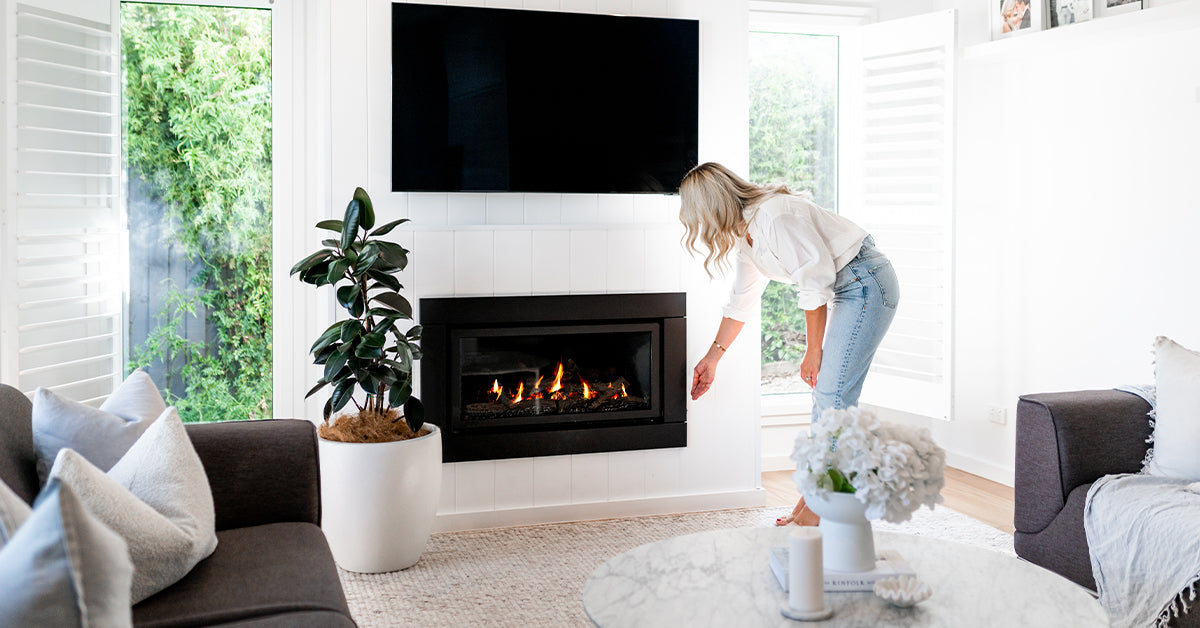
- Mounting a TV too high above the chimney breast. Probably the most common feature wall regret. A TV sitting above a fireplace mantel often ends up high enough to cause neck strain.
- Choosing non-combustible cladding without checking clearance. Some stones and tiles need to be set back further from the fireplace than people expect. Specify the finish only after reading the spec sheet.
- Forgetting the hearth. Gas log inbuilts often need a non-combustible hearth element extending out from the wall at floor level. The hearth dimensions live on the spec sheet.
- Designing the breast around a TV instead of around the fireplace. TV mount heights and fireplace mantel heights rarely align. The fireplace ends up uncomfortably low or uncomfortably high.
The thread running through all five: the cavity drives everything. Get the spec sheet to the carpenter early.
Trade sequencing for a chimney breast renovation
The order of trades matters more than people expect. The cavity dimensions, once framed, lock in everything downstream.
- Carpenter frames the cavity to the spec sheet of the chosen unit.
- Gas fitter rough-ins the gas supply (if a gas log unit).
- Electrician runs power (for an electric unit, integrated lighting, or fan control on a gas log).
- Plasterer or stone mason finishes the chimney breast face and the surrounding wall.
- Painter handles the final wall finish.
- Fireplace installer commissions the unit. For a gas log, this must be a Type A gas-licensed installer working to AS/NZS 5601.1:2022 (Amendment 2, September 2024). For an electric Velisse Aura unit, an electrician handles installation.
Each trade depends on the one before. A plasterer can't finish a wall around a cavity that hasn't been framed correctly. A fireplace installer can't commission a unit if the gas supply hasn't been roughed in. The sequence is fixed by the cavity dimensions.
A chimney breast decision lasts as long as the wall does. Stripping the wall back to studs to redesign a breast that doesn't work is a renovation inside a renovation, and the cost climbs fast. Framing day is when this decision is cheapest to get right.
Bring your floor plan, the chosen fireplace model, and your wall depth measurements to a showroom consultation. Our consultants will work through the three design approaches against your specific room, your flue geometry, and the unit you've selected. We have showrooms in Dandenong, Epping, Geelong, Ballarat, Adelaide, Perth, Sydney, and Newcastle, with manufacturing in Melbourne. Factory-direct pricing applies across all locations.
Frequently asked questions
What is the difference between a chimney breast and a feature wall?
A chimney breast specifically encloses the fireplace and, for gas log inbuilts, the flue path. A feature wall is any wall designed as a visual focal point in the room. A flush feature wall built around a fireplace performs the same structural job as a traditional chimney breast, but reads as a flat wall rather than a projection. In practice, the terms overlap when a feature wall has a fireplace in it.
Can you have an inbuilt fireplace without a chimney breast?
For an electric unit, yes. The cavity is shallow enough to sit within an existing wall depth, and there's no flue to accommodate. For a gas log inbuilt, you still need somewhere for the cavity and flue to live, but they don't have to sit inside a protruding breast. A flush feature wall built out to match the fireplace depth gives the same structural function without the visual projection.
How tall should a chimney breast be in a room with 2.7 m ceilings?
The breast usually runs floor to ceiling in modern designs, which removes the question. If the breast stops short of the ceiling, a balanced finish height sits between the top of the fireplace and roughly 2.1 to 2.4 m, leaving 300 to 600 mm of plain wall above. Lower-profile breasts read more contemporary; full-height breasts read more traditional. Room proportions and surrounding furniture height matter more than a fixed rule.
Can you tile over a plaster chimney breast?
Yes, with the right substrate. Tile-grade plasterboard or tile backer board sits behind the tile to take the weight and absorb the moisture from adhesive and grout. Standard interior plaster is generally not rated for tile. The tiler will tell you what substrate they need before they start.
How much does building a chimney breast add to a fireplace installation?
For a basic protruding breast in framing and plaster, the wall work adds $2,000 to $5,000 on top of the fireplace itself. For a tiled or stone-clad flush feature wall across the full width, the wall work runs $5,000 to $15,000+ depending on the material. The wall finish and the framing depth drive the variance more than the fireplace itself.

Leave a comment
This site is protected by hCaptcha and the hCaptcha Privacy Policy and Terms of Service apply.