
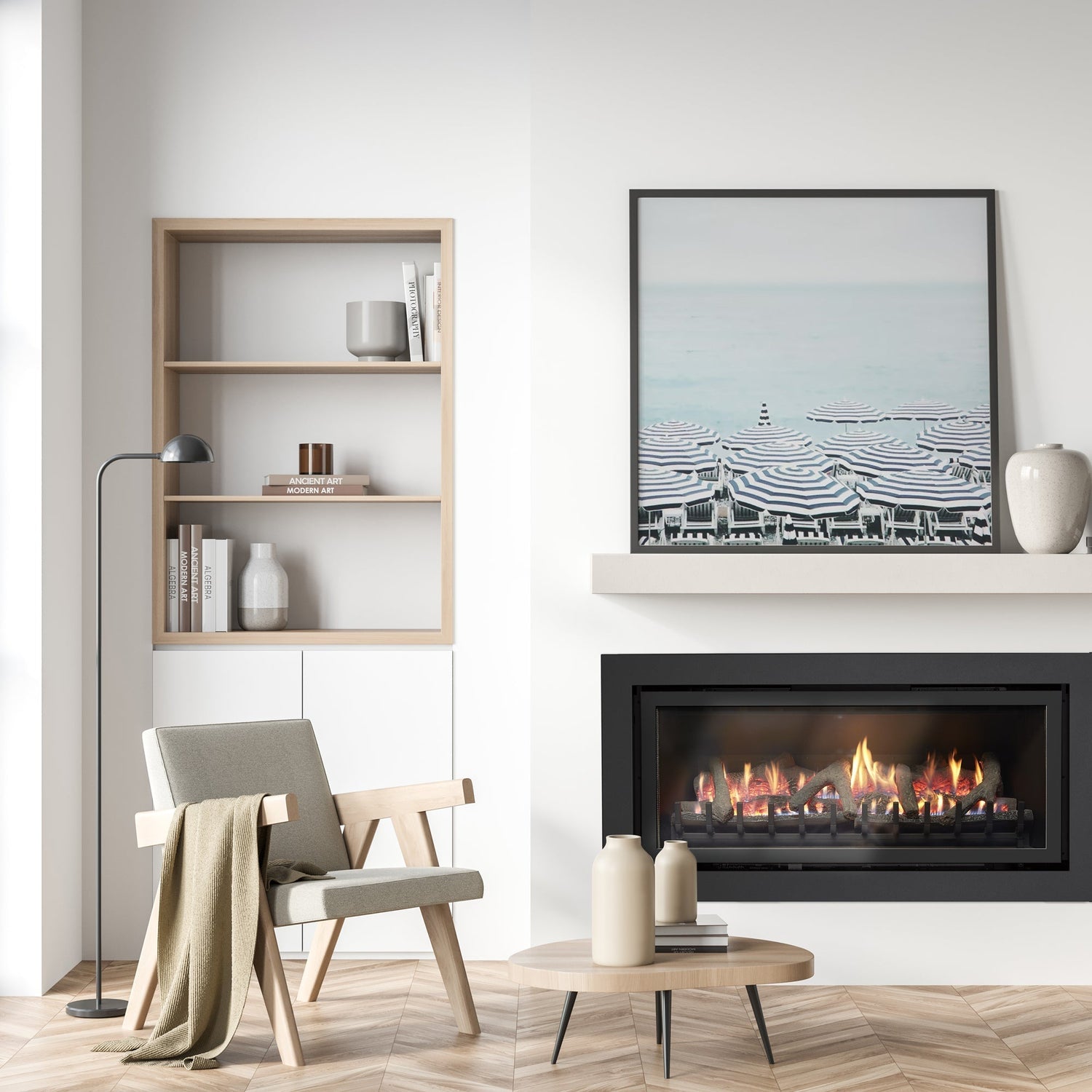
You've got a fake fireplace on the lounge room wall, a mantel and surround that has never held a real fire. Maybe it came with the house: a timber frame with a plaster back, and a couple of candles sitting where the flames should be. It looks the part, but on a cold Melbourne night it does nothing. Now you want a real fire in that spot, and you're weighing up electric against gas.
Here's the short version. If the wall behind your mantel is shallow, or there's no gas connected nearby, a slim-line electric unit is usually the easier and cheaper swap. If you want strong heat and you're happy to build the wall out for a gas unit, an inbuilt gas log fire warms the room harder and gives you a more convincing flame. The right choice comes down to your wall, the heat you need, and your budget.
Illusion Fires offers both: the gas log fires are built in Melbourne, alongside the Velisse Aura electric range. The advice below is written around what these swaps involve in a real home.
What counts as a fake fireplace?
A fake fireplace, sometimes called a faux fireplace, is a surround built to look like a hearth with no working fire behind it. It's there for looks, and it can't burn anything or heat the room. You'll usually know one by what it's missing:
- No firebox. There's no metal or masonry chamber (the firebox is the part that holds the fire).
- No flue or chimney. Nothing carries smoke or fumes outside, because nothing burns.
- A plaster, timber, or MDF surround. The mantel and hearth are decorative, and often hollow behind.
- Purely cosmetic. Any flames are candles, an LED insert, or a painted recess.
Because there's no firebox behind it, you're adding a fire where there has never been one. That's the main thing that separates this job from reviving an old hearth. If your home has a bricked-up chimney or a disused open fire, you're working with a once-functional fireplace, and the options and costs run differently. That case is worth reading up on separately. A fake fireplace starts from a blank decorative shell, so the question is simply which type of fire you can fit into it.
Electric and gas suit different walls, budgets, and heating needs. Here's how the two compare for this kind of fireplace upgrade:
| Factor | Electric | Gas log |
|---|---|---|
| How much heat does it give off? | About 2 kW, enough to warm a small-to-mid room as extra heat | 4 to 8 kW, enough to be the main heat for a living area |
| How much wall depth does it need? | 150 to 200 mm for a slim-line unit | 300 to 450 mm for an inbuilt unit, so the wall often needs building out |
| Does it need a flue? | No flue or venting | Yes. Illusion gas units are room-sealed, drawing air from outside and venting outside through a sealed system |
| What connection does it need? | A standard power point, or hardwiring by a licensed electrician | A gas line, connected by a licensed gasfitter |
| How long does installation take? | 1 to 2 weeks | 3 to 5 weeks |
| What does the unit cost to buy? | $1,500 to $5,000 | $3,500 to $8,000 |
| What does it cost installed? | $2,500 to $7,000 | $5,000 to $11,000 |
| Who is it best suited to? | Shallow walls, no gas nearby, ambience first, quicker or lower-cost jobs | Real radiant heat, gas already connected, heating the whole room |
When electric is the right answer
Electric suits more of these swaps than people expect, mostly because a fake fireplace often sits on a wall that was never built to hold a real fire.
- The wall is shallow. A slim-line electric unit needs only 150 to 200 mm of depth, so it fits a wall that could never take an inbuilt gas firebox.
- There's no gas connected nearby. Running a new gas line adds cost and mess. Electric needs a power point, or a licensed electrician for a hardwired model (one wired straight into the circuit rather than plugged in).
- You're renting, or you want it done quickly. Electric goes in within about 1 to 2 weeks, and many models can be removed cleanly if you move.
- You care more about the look than the heat. Electric gives you the flame effect on its own, so you can run it for ambience without the heat through the warmer months.
- The budget is tighter. Supplied and installed, electric usually lands well below an inbuilt gas job.
A 2 kW electric unit warms a small-to-mid room as extra heat rather than as a home's main heat source. Our guide on whether an electric fireplace will heat your room covers what that means in a real space.
When gas is the right answer
Gas is the better call when you want the fire to genuinely warm the room, and you're prepared to do a little more building work to get there.
- You want real radiant heat, the warmth you feel coming off the fire like sun on your skin. A gas log fire puts out 4 to 8 kW, enough to heat a living area on its own.
- Gas is already connected. If there's a gas line near the wall, the biggest cost variable is already sorted.
- You want the room properly heated. For an open-plan lounge or a large space, gas warms it faster and harder than electric.
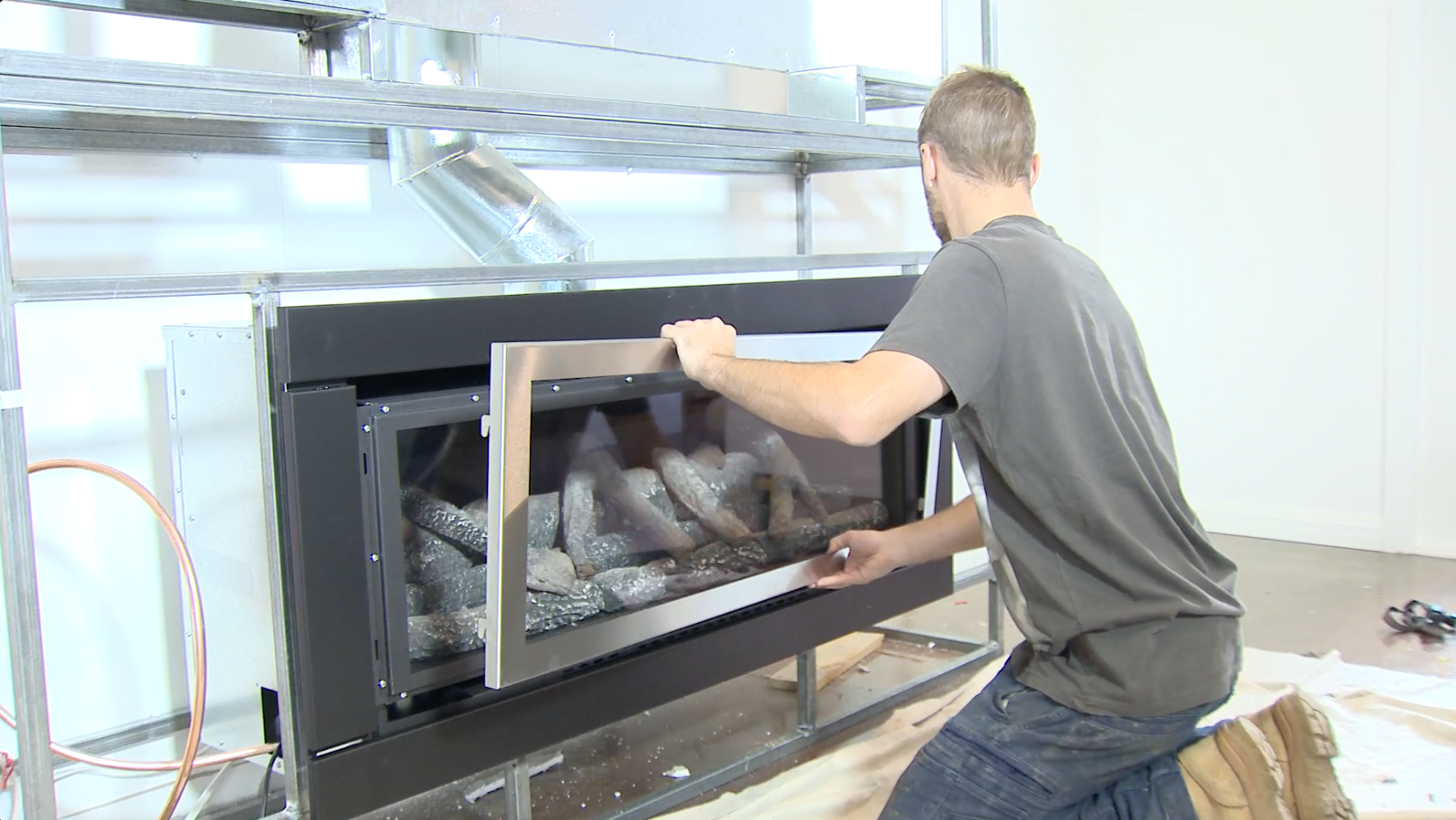
- You're willing to build the cavity. An inbuilt gas unit (one set into the wall) needs a recessed space 300 to 450 mm deep, which often means building the wall out or into the room.
- You want the most convincing flame. Gas gives you a real, moving flame, with radiant warmth coming off the glass.
The flue on a gas unit still needs a clear path to the outside. Illusion's gas fires are room-sealed, so they draw combustion air from outside and send exhaust straight back out through a sealed system, with the glass front sealed shut. Complex flue routing adds to the cost, so it's worth checking early.
What to check before you choose
Before you settle on electric or gas, a few things about your wall and your room decide most of it. Get the match right and you avoid paying for building work you didn't need.
- Wall depth and whether there's a cavity. This is the single biggest factor. A shallow wall with nothing behind the mantel points you toward slim-line electric, unless you build out for gas.
- The age and build of your home. Older Melbourne homes, the Edwardian and inter-war places across the inner and middle suburbs, often have single-brick or thin stud walls with only a cosmetic mantel in front. There's no cavity to drop an inbuilt gas firebox into. In those homes, a lot of these jobs end up going slim-line electric, unless the owner is happy to build the wall out to make room for gas.
- Whether gas is connected. Check if there's a gas line near the wall, or whether one would have to be run from the meter.
- How you'd vent a gas unit. A gas log fire needs a flue routed outside. The straighter that path, the lower the cost.
- The heat the room needs. Match the unit to the space. A 2 kW electric unit suits a small-to-mid room as extra heat; a 4 to 8 kW gas unit can heat a whole living area.
What to bring to the showroom
The quickest way to get a clear answer for your own wall is to bring the right details in. Have these ready:
- Photos of the wall and the existing fake fireplace, from the front and the side.
- Wall measurements, especially the depth available and the width of the recess.
- Whether gas is connected, and roughly how far away the nearest gas line is.
- The location of the nearest power point.
- The room size in square metres, so the heat output can be matched to the space.
- Your style preference, freestanding or inbuilt, and any part of the surround you want to keep.
See both options against your own wall
The clearest way to decide is to see a slim-line electric unit and an inbuilt gas fire running side by side, then hold them against the wall you're working with. Bring your photos and measurements into an Illusion Fires showroom in Victoria, South Australia, Western Australia or New South Wales, and the team can tell you which path suits your wall and quote the full job, unit and installation together. For the gas units, the fireboxes are made in Melbourne, and the 10-year firebox warranty covers the part that takes the most heat stress over the years. Factory-direct pricing keeps a retail markup off the final price on either path.
Common questions about replacing a fake fireplace
Can you put a real fireplace where a fake one is?
Yes, in most cases. A fake fireplace is a decorative shell, so you're adding a fire where there wasn't one. Whether you can fit gas or electric depends on the wall depth, whether there's a cavity, and whether gas is connected. A slim-line electric unit fits the widest range of walls. An inbuilt gas unit needs more depth and a flue.
Do you need a flue for an electric fireplace insert?
No. An electric fireplace insert doesn't burn anything, so there's no flue, no chimney, and no venting. It runs on electricity through a standard power point, or hardwired by a licensed electrician. That's a big part of why electric fits walls that could never take a gas unit.
How much does it cost to replace a fake fireplace?
As a rough guide, a slim-line electric swap runs about $2,500 to $7,000 installed, and an inbuilt gas log fire about $5,000 to $11,000 installed. The gap comes mostly from the gas line, the flue, and building the wall out for the firebox. Your final cost depends on your wall and how much work the install takes.
Can you convert a decorative mantel to gas?
Often yes, though it's more involved than electric. An inbuilt gas unit needs 300 to 450 mm of depth, a flue to the outside, and a gas connection fitted by a licensed gasfitter. If your decorative mantel sits on a shallow wall with no cavity, you'll need to build the wall out to make room. It's very doable, it just takes more work than dropping in an electric unit.
Will installing a fireplace damage the wall?
A slim-line or wall-mounted electric unit usually needs only minor work, and can leave most of the wall intact. An inbuilt gas unit is more involved, since it needs a cavity, so expect some building work and patching afterwards. A showroom consultation and a site check will tell you exactly what your wall needs before anything starts.

Leave a comment
This site is protected by hCaptcha and the hCaptcha Privacy Policy and Terms of Service apply.